About the Course
In Beat Reporting and Writing - Environmental Beat (JMC:3401), students learn how to cover environmental topics, including water and air quality, renewable energy and habitat loss/restoration. They practice field reporting, develop sources, look for data and write timely, compelling news and feature stories on the environmental beat.
Student Work
Ashley Rosales
Author: Ashley Rosales
Animal Agriculture Water Use Exceeds Billions of Gallons Annually in Iowa
If every person in Iowa drank a gallon of water every day for 10 years, that would still not match the 19.2 billion gallons of water permitted every year for animal agriculture.
“Resources are abundant in water, but they're not infinite. It’s important to know how much is being used, and the forecast demand, and the bottom line is we don’t want operations to fail,” Michael Anderson, senior civil engineer with the Iowa Department of Natural Resources, said.
“For all animal feeding operations, we’ve permitted 19.2 billion gallons of water in 2024,” he said. “Actual reported usage is around 5 billion gallons, about 27% of what was permitted.”
Animal producers rely on water heavily. Finding a balance of how they use their water, while trying to remain environmentally friendly, can be a difficult task to manage.
“It’s not just about using less water, it’s about making sure the water we use benefits the animals and crops, without harming the environment,” Ben Wikner, owner of a Clayton County farm, says. He uses around 5,000 gallons a day of water for roughly 2,000 pigs.
For Bob Ryan, who owns a 1,800-acre pig farm near Ryan, north of Cedar Rapids, things are a little different. Ryan uses 400 gallons a day for about 400 pigs.
The DNR issues water permits to those who exceed 25,000 gallons of water a day. Ryan and Wikner operate under that limit, meaning they avoid the permit process.
“It's not difficult to get, if you understand the procedure,” said Mark Schleisman, of M&M Farms.
“I don't disagree with the process. It’s only there to protect the people using the water.”
In addition to raising hogs and having a cow-calf operation, Schleisman and his family grow corn, soybeans and popcorn on their 5,000-acre farm near Lake City, in west-central Iowa, according to Practical Farmers of Iowa.
After determining the water source, whether a well, groundwater, or natural surface water, you begin the application process. A comment period follows in the local newspaper or on the web, opening the process to the opinion of the public.
“People mostly consider the DNR as an expert agency. You know somebody who is charged under the state of Iowa law with making these decisions, but it doesn't happen in a vacuum. We allow public input, and we have ways of problem-solving if something
seems awry or needs more work,” Anderson said.
“What we need to know is where the well is, how deep the well is, and how much water you are proposing pulling from the well,” Anderson explains from the DNR’s side of things.
The DNR continues the review process by analyzing data sets that track groundwater levels, nearby wells, and existing water use to ensure proposed withdrawals do not interfere with surrounding users.
“To make sure it's not going to harm or cause what we call damage to nearby users,” Anderson said.
With no issues from the community, the permit is granted to that farmer. They now have access to a sliver of the 19 billion gallons of water reserved for animal agriculture.
Animals need water to drink, stay cool
Providing the right amount of high-quality water for drinking, cooling, cleaning, and irrigation is essential for a healthy farm.
“One well supplies the water for all of our drinking and personal needs, as well as what the pigs would drink too, and then, as well, we use some evaporative cooling,” Wikner explained.
He uses the most water on his farm to provide drinking water for his animals. That holds true for Ryan, who said pigs drink, on average, a gallon of water a day. Both farmers use smaller amounts of water to mist their animals on extremely hot summer days.
“As far as cooling goes, you know, there's maybe, I would say, for me, a half a dozen days a year, and I bet I don't put more than 100 gallons to cool them. You know, it's basically zero,” Ryan said.
Schleisman, who went through the process of receiving a permit through the DNR, is required to report on an annual basis how much water he uses, but is not required to report what he used that water on. He prioritizes what’s best for his farm, carefully managing water use for all purposes and making a consistent effort to stay within limits while remaining sustainable.
“If it’s bad water, are my cows going to perform? No,” Schleisman said. “So we do everything we can to make sure the land and the water are treated right. You’ve got to work with what Mother Nature gives you and use it smart.
“On all my irrigated fields, I have soil probes that go four feet deep,” he said. The probes help track moisture levels in the soil and determine how much water crops are actually using each day.
“When I apply water with the irrigation pivot, I know how much I apply, and I don’t apply excess, because if you apply excess, it’s only going to hurt the crop, because more water is going to leave the field.”
Reusing rainfall
Schleisman’s sustainable practices don’t stop there; he uses water reuse to ensure efficiency and quality.
“We’re capturing some of that surface water that’s leaving the farm in a pool, a pond, a miniature lake or whatever you want to call it,” Schleisman said. He uses that water to irrigate his field rather than letting it immediately run into the stream.
That reuse system serves more than one purpose. Schleisman said storing runoff in on-farm ponds allows nutrients to be reduced through natural processes before the water is reused for irrigation or released back into nearby waterways.
“That storage has two benefits,” he said. “One, it gives us some water to irrigate with. But it also improves the water quality before it goes into the stream.”
According to Schleisman, water that enters the storage pools with higher nutrient levels often leaves cleaner due to natural biological processes.
“Nitrogen will actually volatilize and leave the water, or the aquatic plants will cycle those nutrients and tie them up,” he said.
Schleisman’s reuse is part of a broader effort to ensure that water supports both agricultural production and surrounding ecosystems. “The least amount of water I can run, the better for me, the better for my crew, and the better for sustainability.”
Efficiency saves money
For smaller farmers, including Wikner and Ryan, water conservation is less about regulation and more about responsibility to their land, animals, and livelihoods.
“Everybody’s trying to be more efficient with their water, because you have to pay to have the liquid removed from the pits underneath as waste,” Wikner said. Modern hog barns commonly use nipple drinkers and wet-dry feeders that produce
water only when an animal activates them, thus reducing overall waste and spillage.
Ryan echoed that mindset, explaining that minimizing water waste is part of routine maintenance on his farm.
“We don’t want to waste, because if we do waste, then it winds up in the pit and you’re going to have to go haul it,” he said. “It also waters down the manure, which is fertilizer.”
State officials monitoring water use
Water scarcity has not yet become an immediate concern in Iowa, but trends in usage and climate variability still require attention, Anderson said.
“In general, the trend is an increase of about five percent every year,” Anderson said.
“It’s not a huge problem, but it’s a potential problem.” Public concern around water use continues to shape the conversation, even as farmers emphasize their connection to the land and surrounding communities.
Mark Schleisman and his wife pose with a Good Farm Neighbor Award, recognizing efforts to maintain positive relationships with nearby communities amid ongoing conversations about agricultural water use.
“We live in the same area as everybody else…We’re just trying to raise safe, healthy food and raise our families in the same place,” Wikner said.
For Schleisman, responding to that concern means staying open to change, avoiding complacency, and acknowledging that sustainability is never finished, even in a state where water remains relatively abundant.
“I encourage everybody to do better.”
Kellen Fife
Beneath an Ancient Crater, Iowa’s Fluoride Debate Takes a New Turn
By: Kellen Fife
MANSON, Iowa — In a small Iowa town built atop a 74-million-year-old meteor crater, even
the drinking water carries remnants of ancient history. The crater, known as the Manson Impact
Structure, traps groundwater that has been sealed underground for thousands of years. Over long
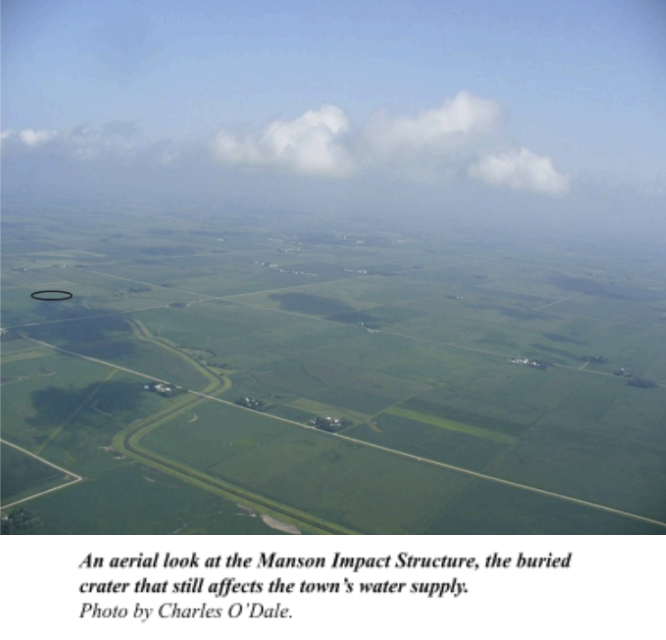
stretches of time, that water
dissolves minerals from
surrounding rock, leaving Manson
with naturally high fluoride levels
that continue to puzzle scientists
and shape local life.
In some wells, fluoride levels have
reached 10 milligrams per liter
(mg/L), far above the
Environmental Protection Agency’s
(EPA) maximum legal limit of 4
mg/L.
“It’s some of the oldest, softest water we’ve ever studied,” said Dr. Keith Schilling, State
Geologist at the Iowa Geological Survey and the IIHR Hydroscience & Engineering. “That
long contact time underground increases the minerals in the water, including fluoride.”
To make the water safe to drink, the state of Iowa mandated that Manson install a reverse
osmosis treatment system, which filters out contaminants, including fluoride, by pushing water
through a semi-permeable membrane. After the system was added, fluoride levels dropped
within federal safety limits.
Yet Manson is not alone. A statewide study published earlier this year, led by Dr. Darrin
Thompson of the University of Iowa’s Center for Health Effects of Environmental
Contamination, revealed that deeper aquifers across Iowa often contain elevated fluoride levels.
The study analyzed thousands of samples from both municipal and private wells and found a
consistent trend: the deeper the groundwater, the higher the fluoride.
The deepest aquifer studied, the Cambrian-Ordovician, which supplies Manson’s groundwater,
has an average well depth of 475 meters and showed the highest mean fluoride concentration at
1.18 milligrams per liter. Statewide, the maximum raw groundwater concentration detected
reached 11.2 milligrams per liter. These findings suggest that many communities across Iowa,
and possibly beyond, may face similar challenges with elevated fluoride levels in their natural
water sources.

“Some of these wells are
tapping very old
groundwater,” Thompson
explained. “In certain areas,
fluoride levels can exceed
what’s considered safe.”
The findings come at a time
when fluoride in public
water systems is drawing
renewed attention. Unlike
most communities that add fluoride to promote dental health, towns like Manson face the
opposite problem: naturally excessive levels that require treatment. National
recommendations have also shifted. In 2015, the U.S. Public Health Service lowered the
ideal fluoridation target from 1.2 mg/L to 0.7, reflecting a more cautious approach to
balancing benefits and risks.
Public debate, meanwhile, has only intensified. U.S. Secretary of Health and Human Services
Robert F. Kennedy Jr. is among the most prominent critics, warning of possible health concerns
and calling for an end to water fluoridation. His position has energized anti-fluoride movements
in several states. Utah and Florida recently passed laws banning the addition of fluoride to public
water systems, citing concerns about neurodevelopmental risks and increased rates of dental
fluorosis.
Despite rising skepticism, Iowa’s public health experts continue to support fluoridation when
levels are controlled. Schilling believes the growing national conversation has created both
confusion and an opportunity for better education.
“There’s misinformation out there, but there are also real questions about naturally high
fluoride that deserve attention,” Schilling said. “The key is monitoring.”
Dental researchers echo that view. Dr. Steven Levy, a leading fluoride researcher at the
University of Iowa College of Dentistry, said fluoridated water remains one of the most
effective and equitable public health tools available.
“It’s especially important for kids and for communities without reliable dental access,”
Levy said. “We’ve seen reductions in cavities for decades.”
He added that in places like Manson, where fluoride occurs naturally at higher levels,
routine testing and treatment systems are necessary to ensure the water remains within
safety limits.
“It is important to know the fluoride levels in your local water, whether it is coming from
natural sources or public systems,” he said.
While researchers analyze the science and shifts in public health guidance, the people
living above the crater experience these issues in far more personal ways.
Alex Hanson, director of the Manson Public Library, grew up in town and said residents have
always known that something unusual lies beneath their feet. What she did not realize until
working at the library was how little of that story is taught in schools.
“We kind of all know about it, but I learned a lot more when I started working at the library,”
Hanson said. “There is a lot they don’t teach us about it at school, which I always thought was
weird.”
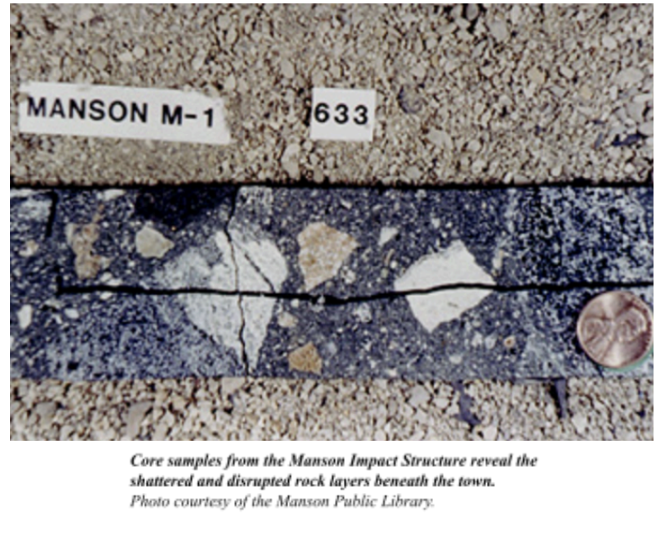
Inside the library, visitors can view core
samples from the crater that show the
disrupted rock layers beneath the town.
Hanson said the samples often spark
curiosity among tourists, though most
locals rarely think much about the impact
structure.
“Most people don’t really care that
much,” she said. “They think it’s cool,
like ‘I live in a crater,’ but we don’t
actually live in a crater anymore. A
glacier filled it in, so it is
just really flat here.”
The crater’s biggest effect on daily life, she said, is the water. Manson’s naturally high fluoride
levels and unusually soft water are widely known in town, and many residents are protective of
their local supply. Still, change appears inevitable. Manson is preparing to receive water piped in from Fort Dodge,
to ensure a stable water supply, a move Hanson said many residents are unhappy about. The new water is expected to reach homes next year. “It is going to be a huge adjustment for all of us,” she said. “We have naturally soft water, and Fort Dodge doesn’t.” Hanson said she and other staff members occasionally meet visitors who come to the library specifically because of the crater’s geology and water chemistry. But tourism has never been a major focus in town.
“It is usually people from out of town who look us up and learn we are in an impact site. Locals do not really come in to learn about it,” Hanson said. Manson’s blend of ancient geology, unique water chemistry, and evolving public health guidance has placed the town at the center of a larger statewide question. As Iowa continues researching its groundwater, communities are being asked to consider how to balance the dental benefits of fluoride with naturally occurring risks and a rapidly shifting national conversation. Iowa’s ancient meteor crater may be quiet today, hidden beneath soil and cornfields, but its influence continues to flow through taps and public debates across the state. As research deepens and communities adapt, Manson’s water story offers a reminder that what happened millions of years ago can still shape the choices Iowans face today.