About the Course
Media and Global Cultures (JMC: 3116) provides an in-depth introduction to a few different ways to think about contemporary media in broader contexts. Tracing the history of media and globalization will demonstrate the uneven adoption and growth of media and cultures across the world. Besides, understanding the idea of "media systems" will provide us with the tools to compare how communication settings vary in terms of markets, political economy, and state intervention. We will also observe the development of online and social media cultures around the world, focusing on the use of such media by governments, causes, and movements. Furthermore, as we inhabit a globalized world with information needs unique to our times, we will learn about global news and journalism cultures.
Student Work
Julia Adomaitis
Author: Julia Adomaitis
Press Freedom Under Pressure:
A Comparative Analysis of Media Systems in China and Brazil
Introduction
In an era where information shapes power and policy, media systems play a pivotal role in defining political legitimacy, economics, and democratic accountability. Across the world, media outlets vary in their degrees of freedom and transparency. Many of these outlets are influenced or controlled by state and private entities. According to Freedom House (2024), only 20% of the global population resides in countries with a “free” press, while the majority live in countries with media systems classified as “partly free” or “not free.” In these environments, press limitations often manifest as restricted transparency, threats and violence against journalists, and concentrated media ownership, all of which constrain the flow of information and democratic accountability. This study aims to explore how China and Brazil differ in terms of media ownership, press freedom, regulation, journalistic independence, and digital adaptation, all within the sphere of censorship. The central question is: How does state and government censorship influence media ownership, press freedom, and digital technologies in China and Brazil, and how does it compare to Western practices?
I chose these countries as my focal point of study because I was fascinated by the rigid environment of China’s media outlets and how it contrasted with Brazil’s moderate environment in the digital landscape. China is known to have an authoritarian model, where the government garners control over traditional media, social platforms, and public discourse. The Chinese Communist Party (CCP) not only censors domestic content but also curates international messaging through media outlets like CGTN and enforces digital isolation through the Great Firewall. In contrast, Brazil is an example of a democratic system with constitutionally guaranteed press freedom. However, Brazil’s media environment faces its challenges from private ownership to misinformation on social media. In a sense, the contrast of these countries is striking, as they lie on opposing sides of the press freedom spectrum.
The goal of this study is to understand how political systems shape media landscapes beyond North American and Western practices and how these influences affect how audiences perceive the news shared by these outlets. By using North America as a reference point, I will highlight the risks that democratic and authoritarian structures can pose to press freedom. This comparative analysis will offer an overview of the broader global trends of media control, resistance, and the shifting of boundaries of press freedom in the digital age.
Literature Review
Previous studies have been conducted to compare media systems in the West. Hallin and Mancini’s (2017) categorization of media developments provided groundbreaking findings in understanding media systems better. Their typology was that Western media systems can be categorized into three models: the polarized pluralist model, the democratic corporatist model, and the liberal model. While these models have significantly shaped comparative media studies, their typology has been widely critiqued for its limited adaptability to non-Western contexts. Factors like press freedom and media ownership often don’t fit into the criterion of the original typology (Herrero et al., 2017). Scholars argue that the political, cultural, and economic practices outside of North America and Europe demand new categories for censorship, state involvement, and digital authoritarianism. Thinking outside of the Western framework is crucial to understanding the globalization of how media systems operate in countries like Brazil and China. Research indicates that the digital landscapes beyond the Western realm may require hybrid or alternative models. This study builds on this critique by examining specific cases in Brazil and China through their systems of ownership, censorship, and press freedom.
The Chinese Media Setting
Many countries with differing media systems actively resist Western journalistic practices, and while major news outlets may form collaborations for the sake of diversity, they often fail to escape their own ideological agendas. China exemplifies this. While non-Western outlets have taken influence from Western practices and critique Western bias, China still engages in selective reporting aligned with its own geopolitical interests. Morales (2022) calls the partnership between CCTV/CGTV and Telesur, a Venezuelan media outlet, an example of “counter-hegemonic” collaboration. However, closer examination reveals hidden ideological agendas behind these partnerships that claim to be apolitical. The guise of press freedom in China is undermined by a highly policed digital environment where content is pre-approved, censored, or deleted when it challenges state authority.
In terms of Hallin and Mancini, it’s understood that China’s political economy does not fit in the model with its state authoritarian environment, with very little room for media autonomy or journalistic independence. Morales’s (2022) analysis of CGTN’s structure supports this claim by illustrating how Chinese state media entities extend past the CCP-aligned narratives through these global partnerships. Morales also notes that these state-run broadcasters aim not only to control internet discourse but also to influence international audience perception of China’s political legitimacy through collaborations and co-productions. This system of ownership ensures that dissenting opinions are suppressed. Independent journalism is illegal when it comes to criticizing government policies and even social issues, which must be framed in favor of state narratives. This authoritarian structure creates an environment where journalism is instrumentalized and public trust can be lost or manipulated through highly curated content.
Perhaps one of the most notable censorship tools in China is the Great Firewall. Also known as the Golden Shield, it is a system of internet censorship and monitoring used by the Chinese government to restrict access to online information within the country (Internet Society, 2023). This system blocks access to thousands of foreign websites like Google, X, YouTube, and most Western news outlets. In this space, the Chinese government instead promotes domestic alternatives like WeChat and other encrypted and closely monitored social platforms.
Not only is the firewall a barrier to information, but also a behavioral tool. Taneja and Wu’s (2014) study argues that web censorship in China doesn’t just restrict access but also influences how users consume their media. Taneja and Wu argue that Chinese citizens are malleable in the sense of cultural proximity. They argue that, in general, people prefer content that is in their own language, allowing for the communication of said content with friends. They also find it easier to derive meaning from local products rather than foreign ones. Each culturally defined marker is a media market that bonds over sharing common cultural traits like language and location. Therefore, Chinese users accept these boundaries that shape their preferences toward state-approved content, which further reinforces CCP ideology.
Digital censorship doesn’t just end with access; it also extends to surveillance and tracking. Online posts are often taken down, and accounts can be deleted or banned when using politically sensitive words that are detected through an algorithm. During intense political times, topics like the 1998 Tiananmen Square protest, which was a public display of citizens’ desire for political and economic reform, and COVID-19 origins were censored and surveilled heavily.
Despite China’s intense governmental control, digital resistance persists with caution. Hao Cao’s (2021) research of the “organizationless” protests in the WeChatsphere highlights how ordinary people use encrypted and ephemeral messaging to organize protests, share information, and build community. These strategies include coded language, images, and temporary online spaces to avoid detection. Cao’s findings prove that even under overwhelming control, digital platforms offer fleeting moments of resistance and autonomy. An example of this is Peter Liang, a Chinese American immigrant police officer who was convicted of fatally shooting an African American named Akai Gurley by accident. This accident resulted in a surge of the hashtag #BlackLivesMatter and protests, along with the emergence of the #Justice4Laing tag. Chinese users on WeChat mobilized this campaign using the organizationless technique. However, with an encrypted platform, most information was cut off from the US and the broader public, which caused US powerholders to have suspicions. This generated anxieties of supervision from China. While it is known that WeChat is used for temporary agency, nevertheless, activism is a risk in China, as citizens can be arrested or even face professional consequences. The Chinese government acts quickly, not only deleting the post but tracing the person who made it as well. In comparison to a democratic system where protests can amplify reform, China’s authoritarian model shuts down resistance before it can start.
Censorship also plays a role in how the Chinese media covers crises. Duan and Takahashi’s (2016) study highlights the stark contrast in media framing using the example of air pollution in Beijing. In the Chinese state media, the issue of poor air quality is reframed as a temporary issue or the government’s commitment to reform. Journalists’ reports emphasize technological innovation, environmental policies, or blame foreign actors for the environmental criticism. The goal of reframing is an example of the state controlling the media. News outlets do not investigate causes or hold polluters accountable but rather reinforce public trust and confidence in times of crisis, which can have serious consequences depending on the context. For example, during the early stages of the COVID-19 outbreak, similar messages were delivered, delaying the public’s understanding of the severity of the virus. This type of reporting would be unheard of in North American contexts, as press independence allows for government accountability.
China’s media strategy is not only domestic. Through platforms like CGTN and Xinhua News Agency, the CCP also extends its narrative abroad. Morales (2022) and Freedom House (2022) both point out China’s growing investment in international media markets, including
Brazil. These efforts are a part of a broader soft power strategy, positioning China as a legitimate global leader while countering Western criticisms of its domestic policies.
Overall, China’s media system exemplifies the extreme end of the authoritarian model. It combines centralized ownership, sophisticated digital censorship, suppression, and international influence to create a state-approved narrative. While Hallin and Mancini’s model offers a foundation for comparison, China continues to exist outside the sphere of democratic media theory. While China’s political structure is unfamiliar to the Western eye, the complexity of its structure serves as a necessity to understanding how authoritarian regimes adapt in the digital age.
The Brazilian Media Setting
Unlike China’s state-controlled system, Brazil’s media landscape operates within a democratic framework, supported by constitutional protections for press freedom and freedom of expression. Referring to Hallin and Mancini’s model, Brazil doesn’t fit neatly into any single category, instead taking characteristics from each. Its media is market-driven and commercially oriented, like the liberal model, while journalism is professionalized and legally protected. At the same time, elite influences over media content reflect traits of the polarized pluralist model. The Brazilian press is dominated by elite influences, such as powerful families like the Marinhos, owners of Grupo Globo, a major media conglomerate. This oligopolistic ownership structure means that, although the press is legally free, it is constrained by economic and political pressures. According to Reporters Without Borders [RSF] (2017), 26 corporate groups control 50
of the country’s largest media outlets across television, print, radio, and online platforms. Consequently, content is often aligned with the interests of media owners, leading to a lack of pluralism and limited representation of marginalized voices. This environment is a media
instrumentalization sphere where content is not shaped by journalistic independence but by political and commercial ideology. The study also highlights patterns of cross-ownership, geographical concentration in Sao Paulo and the southeast, and the role of political and religious affiliations, all of which reinforce elite control over information flows and limit pluralism. This empirical evidence underscores that freedom of the press in Brazil is often constrained by structural ownership dynamics rather than direct state censorship.
Porto’s work (2012) provides a deeper look into how Globo has both shaped and been shaped by Brazil’s transition toward democracy. He traces how TV Globo has historically been aligned with elite political and economic forces but underwent a process Porto calls a “media opening” in the mid-1990s. During this opening, Globo’s news division slowly increased its coverage of “hard news,” which became more responsive to demands from citizens for accountability and revised coverage of presidential elections to include a wider array of perspectives. Porto further argues that this opening wasn’t only for looks but also challenged how Globo’s transformation affected vertical and horizontal accountability and civic society engagement. Despite these changes, Porto emphasizes that Globo’s political and economic power remains strong. Its legacy of close relationships with elites, influence over the narrative, and ability to shape national identity through representation continues to limit how far transformations can go without structural reforms.
The combination of political interests and media narratives in Brazil is further evident in the news coverage of protests and social movements. Mourao and Chen (2020), in their study, analyze Twitter coverage of left and right-leaning protests by Brazilian journalists. They find clear evidence of ideological bias, with coverage of left-leaning protesters emphasizing disorder and violence while the right-wing side demonstrated a neutral and sympathetic approach. This framing is shaped through the journalist’s personal belief and the stance of their affiliated media organizations. These findings highlight a partisan dimension to Brazilian journalism that mirrors the political parallelism that Hallin and Mancini describe. Even as journalists operate in a relatively open media system, the ideological polarization of Brazil’s political landscape influences how news is constructed and consumed. This pattern contradicts the idea of a neutral or objective press and fosters mistrust among Brazilian citizens—a problem North America also has, but in a different structural way.
As in many other countries, Brazil’s media systems have been shaped by the rise of digital and social media platforms. Unlike China, Brazil’s internet access is largely accessible and unregulated, allowing for a wide range of voices and the flow of information. However, this quick flow of information has led to a rise of misinformation, an issue the West faces as well. Misinformation is typically spread through apps like WhatsApp, Facebook, and Telegram, which play a central role in political communication. Misinformation in Brazil is often politically motivated. During the 2018 and 2022 elections, coordinated campaigns were put in place to spread false information about candidates, voting, and government policies, which increased the public’s distrust of institutions. This lack of regulation makes Brazil’s media ecosystem vulnerable to manipulation despite its structure being democratic and having press freedom. This environment is starkly different from China’s, where control is achieved through firm restriction, but the consequences can be similarly destabilizing. In both situations, China and Brazil suffer as their credibility falters. However, for Brazil, this is not due to censorship but rather the fast-
flowing and unchecked false information and the lack of policies to combat it.
In addition to domestic challenges, Brazil also faces challenges from foreign influences, notably from China. According to Freedom House (2022), China has expanded its media presence to Latin America through content syndication deals, media partnerships, and diplomatic outreach. Brazilian outlets have published CGTN and Xinhua content before, providing an indirect channel for Chinese narratives to reach Brazilian audiences. While this is not seen as pervasive, there are concerns about soft power and editorial independence. As mentioned, Morales (2022) notes that China uses international broadcasting collaboration to build legitimacy abroad. From Brazil’s side, they benefit, as this partnership is seen as economically beneficial. However, these concerns surround the worry of subtle influence on the public by framing China’s political model in a positive light. This form of media influence contrasts with the U.S.
model of soft power through Hollywood and tech platforms, which do not operate under governmental influence. China’s implementation in Brazil is strategic and state-narrative driven, furthering the complexity of media systems.
Despite its structural flaws, Brazil maintains a legal framework that protects press freedom and investigative journalism. Independent media outlets like Folha de Sao Paulo and Agencia Publica have published detailed reporting on corruption and political abuses, often
holding powerful entities accountable. However, threats to journalism, particularly in the sectors of crime, politics, or environmental issues in rural areas, are a serious concern. Aggression against journalists in Brazil has impacted the country’s ranking of press freedom, causing their score to consistently fluctuate. As of 2023, their ranking rose as a result of Jair Bolsonaro leaving office, whose presidential term was marked by hostility toward journalists (RSF, 2023). Though these threats in Brazil are not state-driven, China is positioned in a far more concerning environment where those who harass journalists are not held accountable. This puts Brazil in an
interesting position; they are a democracy with strong press traditions and formal protections, but it is weak in terms of institutional and political hostility, exposing journalists to danger. This gap between legal guarantees and realities reflects patterns in polarized democracies, including some aspects seen in the U.S.
Brazil’s media system, in a way, contradicts itself. On one hand, it benefits from legal protectors, journalistic professionalism, and a diverse digital landscape, but is constrained by concentrated ownership, political bias, and misinformation. Unlike China’s authoritarian structure, Brazil’s media system is shaped by indirect and subtle control mechanisms like elite ownership, political support, and funding. While formal censorship is rare, informal pressures and economic dependencies shape the content being released and media narratives. As a result, Brazil represents a hybrid system, one that is democratic in structure but subject to pressure that can decrease the quality and readability of its journalism.
Methods
This study adopts a comparative qualitative case study approach to examine how political structures, regulatory frameworks, and media environments interact with China and Brazil. The objective is to compare these two countries’ media systems in terms of state regulation, ownership, press freedom, and digital media, while using North America as a reference point in comparison to non-Western practices. While both countries are vastly different in terms of regimes, they share experiences of media manipulation, political influence, and digital disruption to different degrees, which makes them suitable to compare. My comparison focuses on 4 main categories: (1) Government control/censorship, (2) Ownership and political influence, (3) Public trust and journalistic independence, and (4) The role of digital and social media. These categories reflect Hallin and Mancini’s media theory and the extensions that non-Western systems require. This analysis will be separated into similarities, differences, and future implications.
Procedures
To ensure credible sources for the analysis, this study pulls data from peer-reviewed academic articles, government reports, guild websites, and case studies. The research process is organized in these steps:
- Literature review: Hallin and Mancini (2017) is used as a foundation for analyzing media systems using the Western model as a pointof reference to further understand and critique the model.
- Sources used: Academic articles are pulled from journals within databases like JSTOR, SAGE Journals, and Google Scholar. There is also usage of reports from Reporters Without Borders and Freedom House.
- Content analysis: Specific events such as the Tiananmen Square and Black Lives Matter protests, COVID-19, and Brazil’s 2018 and 2022 elections were analyzed using secondary data from scholarly articles. These events helped create a picture of how media systems operate under pressure and during times of crisis.
Cross comparison: After the individual country analysis, findings were then compared in the final reflection, and how each country compares to the North American and Western models.
Materials
- Academic sources from peer reviews (Class sources—Hallin and Mancini, Hao Cao, Morales, Mourao, and Chen)
- Academic sources from peer reviews (Outsourced—Herrero et al. and Porto)
- Empirical research on censorship and behavior (Taneka and Wu, Duan, and Takahashi)
- NGO and government reports (RSF and Freedom House)
- Global Index Media (World Press Freedom Index)
Results
After researching, I found that Brazil is ranked much better with press freedom than China. According to the RSF World Press Freedom Index (2024), China is ranked 178 th out of 180 countries, reflecting a highly repressed state of media where journalism is controlled by the state. As for Brazil, it holds the 82 nd position, indicating a media landscape that is constitutionally protected but still faces challenges like violence against journalists.
Hallin and Mancini’s (2017) typology of Western media systems provides useful points of comparison here. They identify the three models as the polarized pluralist, the democratic corporatist, and the liberal model. The polarized pluralist model is characterized by high political parallelism, instrumentalization of media by state parties, and weak commercial press development. The democratic corporatist model acts as a middle ground as it balances press freedom with professionalization and social institutions that support both state and market influence. The liberal model, on the other end of the spectrum, emphasizes private ownership and low levels of political parallelism.
In terms of media ownership, we know that China is predominantly state-owned, with the government exerting strict control over content. Independent journalism is essentially nonexistent. This exceeds even the polarized pluralist model and exemplifies how China lies outside of Western-based frameworks. Brazil, however, illustrates a different dynamic of media ownership, as its system is concentrated on powerful families and conglomerates. As previously mentioned, RSF (2017) reported that 50 major mass media outlets are owned by 26 corporate groups like Globo Group and Record Group, which demonstrates how a small number of entities
can significantly influence editorial styles and limit pluralism. This concentration of private ownership, combined with political influence, means that Brazil also does not fit neatly into the polarized pluralist, democratic corporatist, or liberal models. It is neither dominated by the state nor characterized by a fully professionalized or pluralistic press, making its system a hybrid that challenges Western-based frameworks.
Digital media usage and censorship in China have a vast digital user base, with about 1.06 billion active social media users as of January 2024. However, the government implements strong censorship like the Great Firewall to monitor users. Again, this level of state
instrumentalization pushes beyond Hallin and Mancini’s framework, suggesting that their model does not fully capture the digital landscapes in non-Western systems. Brazil has about 187.9 million internet users at the start of 2024, but the country is still facing challenges with misinformation on apps like WhatsApp and Facebook, which has affected narratives of candidates in elections.
Finally, as for journalist protection, China operates under strict restrictions. RSF (2025) reports that over 100 journalists are currently detained, making it the largest jailer for journalists. The state-controlled environment persists using manipulation, surveillance, and suppression of independent reporting. As for Brazil, while the 1988 Federal Constitution guarantees freedom of the press, journalists often face threats, harassment, and violence, especially when reporting on sensitive topics like corruption or organized crime. The country lacks strong policies for protecting journalists, leading to an insecure professional environment.
Discussion and conclusions
The findings of the study suggest that while both countries face challenges in media independence, they differ in the degree to which their systems operate through state control, press freedom, and regulation. In China, the state has full control over the media, enforcing ideological conformity through censorship, manipulation, and surveillance. The press is primarily used as a tool to enforce power. In contrast, Brazil’s media environment is constitutionally supported but weakened by high powers of ownership, political affiliation,
misinformation, and journalistic rights.
While China represents the extreme end of the spectrum of authoritarian regimes, Brazil reflects a hybrid system, where democratic practices coexist with elite influences. This exemplifies that threats to media freedom are not only exclusive to powerful entities but also
include many other aspects to foster a specific media environment. One of the most striking differences between these countries is how their digital media operates. While China is under heavy surveillance, platforms like WeChat allow for resistance, revealing that even in intensely surveilled spaces, citizens can briefly protest. On the other hand, Brazil has the opposite challenge. With unregulated digital platforms, misinformation spreads quickly; this leads to confusion, chaos, and erosion of credibility within the journalistic press. These contrasting issues present a global paradox. While digital tools can empower citizens and journalists, they can also be used as a form of suppression or manipulation of the truth.
By using North America as a reference, the study of China and Brazil is valuable, as it gives a greater understanding of media systems that many are not familiar with. It also suggests that no media system is immune to political or economic manipulation and different degrees of control. China is controlled by state coercion, while Brazil is influenced by structural inequalities, and North American systems are challenged by corporate concentrations, algorithmic systems, and misinformation. Therefore, this study contributes to a more nuanced understanding of global media systems by demonstrating that press freedom exists on a spectrum rather than a binary. Structural independence is just as important as legal protections; digital resistance requires technological literacy and regulation to counter manipulation and censorship, and foreign media influence is an emerging issue even in established democracies.
Looking toward the future, the findings of this study suggest a few possible trajectories for the future of the press. In China, while freedom of the press is unlikely, resistance from citizens could create temporary forms of freedom, especially among young people. While China commits to building legitimacy across borders, international pressure remains on the CCP for reform in its press. In Brazil, the path forward could depend on institutional reform. However, increasing the regulation on social media platforms would greatly aid in decreasing misinformation and would improve the public’s trust in the press.
Globally, this study reinforces the need for comparative media research, one that transcends Western models and ideology. Understanding authoritarianism and democracy is important to developing theories of media systems beyond our own. Overall, this comparative study has shown that while China and Brazil operate under vastly different political systems, both face significant threats to a free and independent press. China’s authoritarian approach and Brazil’s elite-controlled environment of misinformation reflect two ends of the spectrum, each with its own dangers. By comparing these systems while also comparing them to the Western model, this study contributes to a deeper understanding of the challenges and complexities of media systems and the digital age. Media freedom is no longer just about censorship and expression; it has many contributing factors that include ownership, political and geological ideology, and domestic and foreign influences. As the world becomes more digitally inclined, these tensions will only grow more complex, and understanding the foundations and framework is essential to understanding the media’s role in society.
References
2023 World Press Freedom Index – Journalism threatened by fake content industry. RSF. (2023).
https://rsf.org/en/2023-world-press-freedom-index-journalism-threatened-fake-content-
industry
Cao, H. (2022). Organizing an “organizationless” protest campaign in the WeChatsphere. Big
Data and Society.
China. Reporters Without Borders. (2025, September 8). https://rsf.org/en/country/china
Does the Great Firewall really isolate the Chinese? Integrating access blockage with cultural
factors to explain web user behavior (2014). Retrieved May 5, 2025, from
https://arxiv.org/pdf/1305.3311
Duan, R., & Takahashi, B. (2016). The Two-Way Flow of News: A comparative study of
American and Chinese newspaper coverage of Beijing’s air pollution. The International
Communication Gazette, 79.
Herrero, C., Humprecht, E., Engesser, S., Brüggemann, M., Büchel, F., Laia, C., Herrero, &
Castro, L. (2017). Rethinking Hallin and Mancini Beyond the West: An Analysis of Media
Systems in Central and Eastern Europe. International Journal of Communication, 11,
4797–4823. https://ijoc.org/index.php/ijoc/article/viewFile/6035/219
Internet Society. (2023, December 13). The Chinese firewall. Internet Society.
https://www.internetsociety.org/resources/internet-fragmentation/the-chinese-
firewall/?gad_source=1&gad_campaignid=19723249098&gbraid=0AAAAADqyrA8U_gv
VXKCYXR-wtPikfvZ85&gclid=Cj0KCQjwlMfABhCWARIsADGXdy87CWojDeJcJ0Zx-
DZ829DRsYohYY5Dgwmpq003Up340Q3sIdZKhJ4aAubIEALw_wcB
Morales, P. S. (2022). Counter-hegemonic collaborations or alliances of the underdogs? The case
of Telesur and Al-Mayadeen, RT, and CGTN. Global Media and Communication, 18.
Mourao, R. R., & Chen, W. (2020). Covering protests on Twitter: the influences on journalists’
social media portrayals of left- and right-leaning demonstrations in Brazil. The
International Journal of Press/Politics, 25.
New report: Election manipulation and armed conflict drove 18th consecutive year of decline in
freedom. Freedom House. (2024, February 2). https://freedomhouse.org/article/new-report-
election-manipulation-and-armed-conflict-drove-18th-consecutive-year-decline
Porto, M. P. (2012). Media Power and Democratization in Brazil.
https://doi.org/10.4324/9780203119631
Reporters Without Borders. (2017). Media oligopolies: controlled by colonel dynasties.
https://rsf.org/en/media-oligopolies-controlled-colonel-dynasties-rsf-and-intervozes-
present-media-ownership
Reporters Without Borders. (2024). World Press Freedom Index 2024. RSF.
https://rsf.org/en/index?year=2025
The Chinese regime’s fierce repression of journalists hidden behind a day of celebration. (n.d.).
RSF. (2024). https://rsf.org/en/chinese-regime-s-fierce-repression-journalists-hidden-
behind-day-celebration
Young, E., Anonymous, & Cook, S. (2022). Brazil: Beijing’s Global Media Influence 2022
country report. Freedom House. https://freedomhouse.org/country/brazil/beijings-global-
media-influence/2022
Ava Craine
Author: Ava Craine
A Cross-National Comparison of Swedish and Vietnamese Media Systems
Introduction
As modern technology evolves, state intervention has come under increasing scrutiny for its impact on press freedom. Across the globe, governments shape media systems in a variety of ways, many of which will be explored in this paper. This paper examines two contrasting cases: Sweden and Vietnam. These two countries occupy two extremes on the world press freedom scale, with Sweden consistently ranking as one of the freest environments and Vietnam as one of the harshest. Additionally, they have opposing political regimes with different legal frameworks. Sweden is a liberal democracy, while Vietnam is a single-party autocracy. These factors make for an interesting comparison as the countries encapsulate two ends of a spectrum. The main research question guiding this comparison is: How does state intervention affect press freedom in the media systems of Sweden and Vietnam? By examining how both Swedish and Vietnamese governments intervene within their media systems, this paper argues that state intervention fundamentally shapes the extent of a country’s press freedom.
Literature Review
This literature review outlines the key theoretical debates surrounding media systems, state intervention, and press freedom. These frameworks will later be applied to two contrasting political contexts to assess how these factors shape media environments.
Media Systems
As one of the most discussed and debated theories in communication studies, Hallin and Mancini’s (2004) media systems theory offers a lens to understand how media interacts within a broader political, cultural, and economic context. Within this framework, Hallin and Mancini propose four major dimensions for comparing media systems: (1) the development of media markets; (2) political parallelism, or the degree of the links between political parties and the media; (3) the development of journalistic professionalism; and (4) the degree and nature of state intervention in the media system (Hallin & Mancini, 2004, p. 21). While all four of these dimensions are key factors for analyzing media systems, this paper will primarily focus on state intervention.
However, it is also important to note the debate surrounding Hallin and Mancini’s work. Many scholars have criticized this theoretical framework. Mattoni and Ceccobelli categorized the four broad categories of critiques. First, scholars have contested the theoretical and
methodological bases of their system. Second, the framework presented cannot be generalized for non-Western countries. Third, the four dimensions are too descriptive and need quantitative measures. And finally, the framework needs to be updated to consider the role of information and communication technologies (2018, p. 542). However, Hallin and Mancini addressed these limitations in their follow-up paper “Ten Years After Comparing Media Systems.” In this, they clarified their original work and commented on other scholars' critiques (Hallin & Mancini, 2017, pp. 155-171).
State Intervention
State intervention is the concept referring to the active involvement of the state in the media. As restated in Mattoni and Ceccobelli’s paper, Hallin and Mancini identified three indicators of state intervention: (1) putting money into a public broadcasting company, (2) providing news organizations or journalists with direct and/or indirect subsidies, and (3) regulating media concentration, ownership, and competition. While Mattoni and Ceccobelli agree that these indicators are still relevant, they observe that the indicators do not account for information and communication technologies (ICTs). Therefore, they proposed two additional indicators: (4) investments in digital infrastructure and (5) policies on digital media actors and content (Mattoni& Ceccobelli, 2018, 544). These five indicators will later be used to analyze the degree of state intervention in Sweden’s and Vietnam’s media systems.
State Regulation
Overall state regulation of the media refers to laws and institutional frameworks enforced by governments or their agencies to control various aspects of media. In their 2017 work, Hallin and Mancini identify several elements of state regulation: regulation of media ownership, regulation of the use of state pressures to influence media ownership, regulation of journalistic practice,
regulation of election campaigns and coverage, right of reply and hate-speech laws, and regulation of content produced in the national language (p. 161).
The concept of state regulation is often in debate, even with itself, due to its dual nature. State regulation can be enacted for both protective and repressive purposes. Sousa and Fidalgo assert that regulation should be regarded in both a positive and negative manner (2011, p. 333). In this analysis, they promote regulatory measures as a necessary concept in upholding media responsibility and accountability in pluralistic, democratic societies. In their article, they also propose that regulation in the media-market relationship of democracies is the best way to preserve both media and consumer freedom (Sousa & Fidalgo, 2011, p. 334).
While Stier (2015) agrees with the positives of regulation in a democratic setting, stating “weak regulation could induce dynamics that threaten journalistic freedom,” he points out the downside of regulation in non-democratic regimes (p. 1276). According to Stier, all autocratic regimes employ regulative power over the media to preserve their rule. In his work, he demonstrates that these regulatory measures stifle media freedom in autocracies (2015, p. 1277).
Albuquerque (2022) agrees that authoritarian regimes’ regulations restrict press freedom. However, he takes it a step further by pointing out that states classified as “transitional democracies” under the Stage of Democracy Development (SDD) model also display these
repressive regulatory tendencies (p. 487). Therefore, it can be concluded that even states with a democratic-looking framework can mask authoritarian practices.
Press Freedom
Press freedom is a fundamental aspect of any society as it promotes social and economic development. A large body of literature supports this view and reaffirms that media freedom is essential. As stated in the United Nations Universal Declaration of Human Rights, everyone has the right to “hold opinions without interference and to seek, receive and impart information and ideas through any media and regardless of frontiers” (1948, art. 19). It is almost unilaterally agreed that press freedom is necessary, however, there is significant debate within scholarship as to its specific components.
Stier (2015) identified three dependent indicators of press freedom. These are the extent of political interference, constitutional and regulatory means, and independence of editorial decisions from private or commercial interests. He then simplifies his framework to the political, legal, and economic environment of the press. This approach focuses on examining the structural components of a free press (p. 1274).
In contrast, Becker et al. mention that press freedom is contingent on three components: the absence of government restraints, the absence of non-governmental restraints, and conditions existing to ensure the spread of diverse ideas to large audiences (2007, p. 6).
However, Sousa and Fidalgo (2011) insist that removing the obstacles to a free-functioning press is only part of the story. They stress the importance of the people’s right to “complete, comprehensive, pluralistic, true and fair information” (p. 335). In other words, Sousa
and Fidalgo emphasize that freedom cannot be dissociated from its effective exercise. Based on this definition, it can be assumed that not all media regulations negatively impact press freedom.
In agreement with this perspective, Becker and other scholars provide a distinction between negative press freedom, the absence of legal controls, and positive press freedom, the ability to use the media (2007, p. 6). With all these differing definitions and press freedom concepts, it is important to establish a particular framework for this paper’s analysis. For this study, press freedom will be defined by
three core components: (1) legal and constitutional protections of the press, (2) the degree of political interference with media operations, and (3) the economic structural independence of media institutions. These dimensions will guide my analysis of how state intervention influences press freedom. This definition draws primarily on Stier’s (2015) approach to structural press freedom. This framework was selected because it is particularly relevant for comparing across regime types due to its emphasis on institutional and systemic factors rather than normative ideals.
Regime Type
Within comparative political communications studies, the Stage of Democracy Development (SDD) classification is often used as the standard for analysis. This model has three basic categories to classify societies: (1) established democracies, (2) transitional democracies, or (3) authoritarian regimes. Additionally, according to Albuquerque, the SDD classification also lies upon two premises: democracy is the best existing political system, and Western democracy is the only legitimate model of democracy. In his paper, Albuquerque identifies several issues with this classification system. He claims it enshrines ethnocentric prejudices, lacks analytical
consistency, and is becoming increasingly obsolete while the global order becomes more multipolar and Western democracies experience a major political health crisis (2022, pp. 479-481).
Empirical studies have demonstrated a relationship between a country’s press freedom and political regime type. However, these studies use a gradual degree of democratization, in accordance with the SDD model, as the unit for statistical analysis. However, as Stier (2015) pointed out, this system fails to adequately explain the variation in diverse autocratic regime types. To combat this, Stier examined press freedom within six different autocratic regime types: communist ideocracy, electoral autocracy, one-party autocracy, military autocracy, monarchy, and personalist autocracy. His results found that within the autocratic regime spectrum, electoral autocracies, monarchies, and military regimes have the freest media; personalist and non-ideological one-party regimes have intermediate media freedom; and communist ideocracies have the least free media (2015, pp. 1273-1281).
Case-Specific Scholarship
Scholarship on Sweden’s media consistently highlights the country’s strong democratic traditions and its distinctive use of state intervention to defend, rather than suppress, media freedom (Jakobsson et al., 2021, p. 380). Additionally, the press system is supported by a strong accountability structure (Weibull & Börjesson, 1992, p. 137). At the same time, scholars have observed that increasing ownership concentration of a few dominating media companies challenges Sweden’s goal of creating media markets and competition (Jakobsson et al., 2021, p.384).
Literature on Vietnam’s media presents a striking contrast to Sweden, with state intervention primarily used in terms of censorship and political control. In Vietnam, the Communist Party heavily controls the media. The party manages both media activities and the business activities of media entities (Huyen & Trung, 2019, p. 24).
Gaps and Comparison
Previous scholars have extensively studied the relationship between state intervention and media freedom, especially within different political contexts like democracies or autocracies. However, much of the existing literature is focused on either liberal democracies or authoritarian systems, without comparing directly how different methods of state intervention function across highly contrasting political regimes. Additionally, comparative studies typically emphasize Western liberal democracies, with little research being done on non-Western or single-party states. Sweden has often been used as a model of democratic media, but the Vietnamese media system
has few papers examining its media system. Furthermore, literature tends to study Sweden and Vietnam in isolation. Few studies have been conducted to directly contrast these two states to understand how different state intervention methods influence press freedom outcomes.
This comparative case study addresses these gaps by conducting an analysis of Sweden and Vietnam. It contributes to existing scholarship by demonstrating how contrasting forms of state intervention shape media systems. In addition, it examines how these media systems can either uphold or restrict press freedom. By studying these two specific cases, this research aims to deepen scholars’ understanding of how state intervention operates across contrasting media systems.
Methods
This comparative case study is structured around the key dimension of state intervention. This dimension will be used to analyze how they affect press freedom in Sweden and Vietnam. This research will cover public broadcasting, government subsidies, regulations, digital infrastructure, censorship, and press freedom in Sweden and Vietnam. These countries were specifically selected for their contrasting political and media environments, which allow for a meaningful comparison of state and media dynamics.
The data for this study was drawn primarily from a combination of academic literature, government documents, legal texts, and reports from non-governmental organizations such as Freedom House and Reporters Without Borders.
Results
This section presents the findings of the comparative case study of Sweden and Vietnam, focusing on how state intervention influences press freedom. In these results, each country is presented side-by-side to highlight key similarities and differences.
Public Broadcasting
Public broadcasting in Sweden is mostly free from political and commercial influence. However, the Swedish government does have partial ownership of SVT. Sweden, like other Nordic countries, has public service broadcasting in the majority. For radio, public service radio makes up 65 percent of the channels (the other 35 percent being private). Similarly, Sweden’s public service television, SVT, also has a strong position in Nordic television (Weibull & Wadbring, 2010, p. 5). The following table (Figure 1) breaks down the different broadcasting companies’ channels.
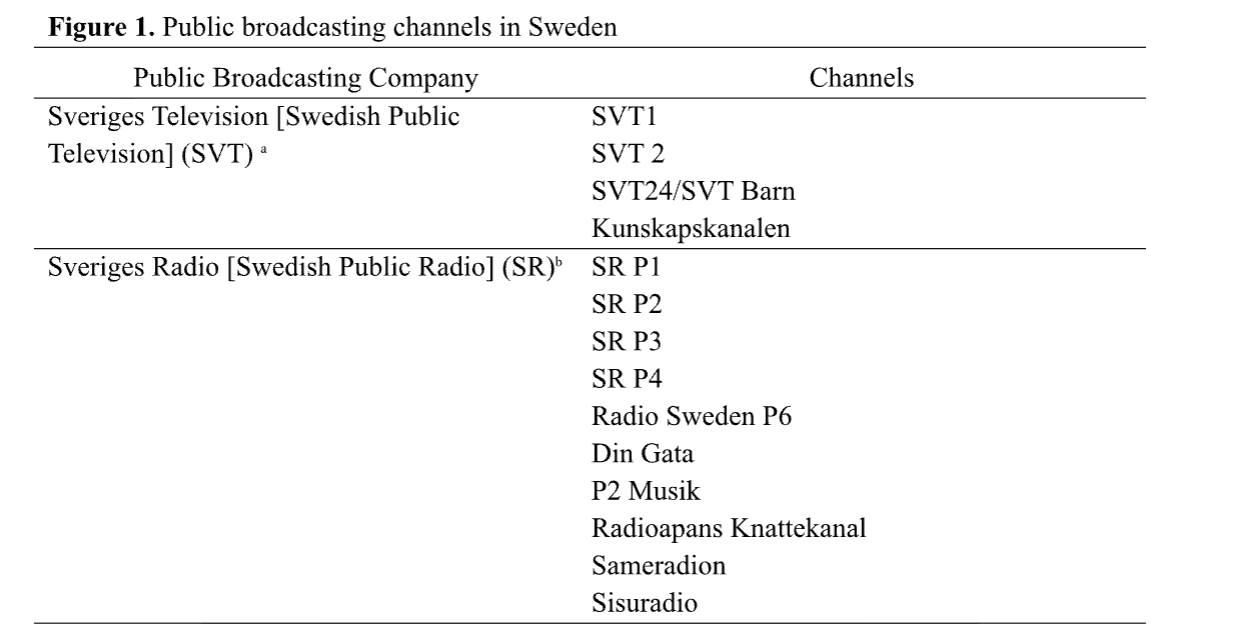

In Vietnam, no true public broadcasting exists as none of their media is without political influence. All legal Vietnamese media is government-owned and controlled. The 2016 Press Law, alongside 19 other legal documents, regulates the ownership of news in Vietnam. In accordance with the law, all news outlets must register under a government organization, a communist party organization, or a social, religious, or political group at the provincial level or higher. However, associations (sociopolitical, sociopolitical-professional, or socio-professional organizations), which have slightly less government control, are also allowed to own media (Tran & Diep, 2024, p. 2).
Government Subsidies
In Sweden, the purpose of these media subsidies is to “promote public access to independent news media” (United Nations Educational, Scientific and Cultural Organization, 2020). The subsidies’ aim is not to intervene in the functioning of the market, but rather to support a market for journalism (Jakobsson et al., 2021, p. 381). The Swedish subsidy system is based on three elements. The first measure is the joint distribution subsidy. This subsidy pays newspapers a small sum per copy to distribute through a joint distribution system using the existing distribution system of the leading newspaper. This system was created to remove the delivery barrier for smaller newspapers. The second measure is a government fund offering loans to weak newspaper companies needing to update their technology. The third measure is production support, or direct cash subsidies to the publishing business. Overall, the production subsidy accounts for the largest share of the subsidy costs (Gustafsson et al., 2009, pp. 7-8). Additionally, the target of Swedish media subsidies is local news journalism, especially in areas with lower media coverage (United Nations Educational, Scientific and Cultural Organization, 2020).
Among the seven Vietnamese legal documents regarding state subsidies for news organizations, Huyen and Trung (2019) identified four themes: (1) documents regulating the postal/mail services for newspaper distribution, (2) free distribution copies for people in remote
areas, (3) free training, free renovation, and cost subsidies for remote areas’ programming, and (4) direct subsidies for news organizations (p. 20). The Vietnamese government provides full subsidies for newspapers that serve primarily as Communist Party mouthpieces. Financially independent news organizations carrying out the Party’s orders also receive partial subsidies. For broadcasting organizations, the state-owned bodies subsidize them based on need. (Huyen &Trung, 2019, p. 20).
Regulations
Swedish public media is regulated by an independent broadcasting commission. On January 1, 2024, the Swedish Press and Broadcasting Authority (MPRT) and the Swedish Media Council (SMC) merged to become the Swedish Agency for the Media (“Mediemyndigheten”). Among the Swedish Agency for the Media’s duties, it is tasked with licensing, registration, and supervision of the media, as well as monitoring and analysis of the media market. The agency is also organized into five units: (1) the permits and media support unit, (2) the supervision and review unit, (3) the investigation and analysis unit, (4) the communication and promotion unit, and (5) the administration unit (European Platform of Regulatory Authorities, 2024).
In Vietnam, the media regulatory body is the Ministry of Information and Communications. The Ministry is a government agency that exercises state management of a number of areas. These areas include, but are not limited to, the press, publication, printing, distribution, broadcasting, news, telecommunication, and foreign information (Ministry of Information and Communications, 2022). In other words, it places all aspects of regulating information and communication under the state.
Digital Infrastructure
Sweden is widely recognized as a digital innovation leader and consistently ranks in the top countries for Information and Communication Technology (ICT) readiness and adoption (International Trade Administration, 2024). Internet users in Sweden make up 96% of the population (The World Factbook, 2025a). This means about 10,166,241 Swedes use the internet. There are also 4.3 million fixed broadband subscriptions in the nation (The World Factbook, 2025a). According to a survey by Schrøder et al., digital sources are the main method of news consumption in Sweden. In the results, 77% of participants’ main source of news was a digital source (2020, p. 29). In looking at the Swedish government’s investments in digital infrastructure, 5.8% of Sweden’s GDP in 2021 was in the Information and Communication Technology (ICT) sector.
In Vietnam, 78% of the population uses the internet (The World Factbook, 2025b). Based on the population, this means 82,492,000 Vietnamese are internet users. Vietnam also has 22.8 million fixed broadband subscriptions (The World Factbook, 2025b). The state, aside from government programs, provides support for increasing digital infrastructure via investment laws, promotion of science and technology, taxes, and small- and medium-sized enterprise (SME) assistance. The government provides incentives for digital infrastructure investment through the 2019 Law on Investment. This provides investment incentives for key industries, including
information technology products, software, and digital content. Vietnam has also recently enacted strategies to increase digital infrastructure (Chuc & Anh, 2023, 132). The Prime Minister signed a decision to enact the Digital Infrastructure Strategy. This strategy aims to expand 5G mobile networks to 99% of the population, operate at least two new international undersea fiber optic cables, and grant each citizen Internet of Things (IoT) access, among other objectives, by 2030 (Ministry of Science and Technology, 2024).
Censorship
While Swedish media may not have explicit government censorship, journalists still experience a phenomenon called self-censorship. Online threats are common for Swedish journalists, with almost one in five reporters stating they have been the victim of harassment. Although the risk is relatively low, journalists who are women, columnists, and immigrants face a higher risk of threats and physical attacks (Reporters Without Borders, 2025a). In Kamali’s work, in-depth interviews with Swedish journalists of immigrant backgrounds were conducted. In these interviews, the journalists discussed self-censoring themselves as a way of protecting their jobs (2021).
Media censorship in Vietnam often is built into the laws. News organizations in Vietnam can be fined for violating published content rules, most often concerning Article 9 of the 2016 Journalism Law. Article 9 bans “publishing and broadcasting information against the State and the Party; fake news and information; information that discriminates against other people, information that offends the nation and national heroes; violent information; privacy information; etc.” (Huyen & Trung, 2019, p. 21). To control media further in Vietnam, the army developed Force 47, which is a unit of 10,000 cyber-soldiers tasked with defending the party line and attacking all online dissidents, and Steering Committee 35, a large network of cyber troops (Reporters Without Borders, 2025b).
Press Freedom
The two press freedom indicators being examined in this paper are Freedom House and Reporters Without Borders (RSF). Freedom House assesses the political, legal, and economic environments of each country to evaluate if the country promotes the free flow of information. The legal environment is scored on a 30-point scale, the political environment on a 40-point scale, and the economic environment on a 30-point scale. On this index, a higher score indicates higher media freedom (Becker et al., 2007, p. 9). The other index being analyzed is Reporters Without Borders, which examines five categories: physical and psychological attacks on journalists, legal harassment of and discrimination against journalists, obstacles to collecting and disseminating information, and government manipulation of the media. To create its index, RSF uses a 53-item questionnaire and weighs each of the questions. On this index, a lower score indicates higher media freedom (Becker et al, 2007, p. 11). Figure 2 presents Sweden and Vietnam’s scores on both indices.
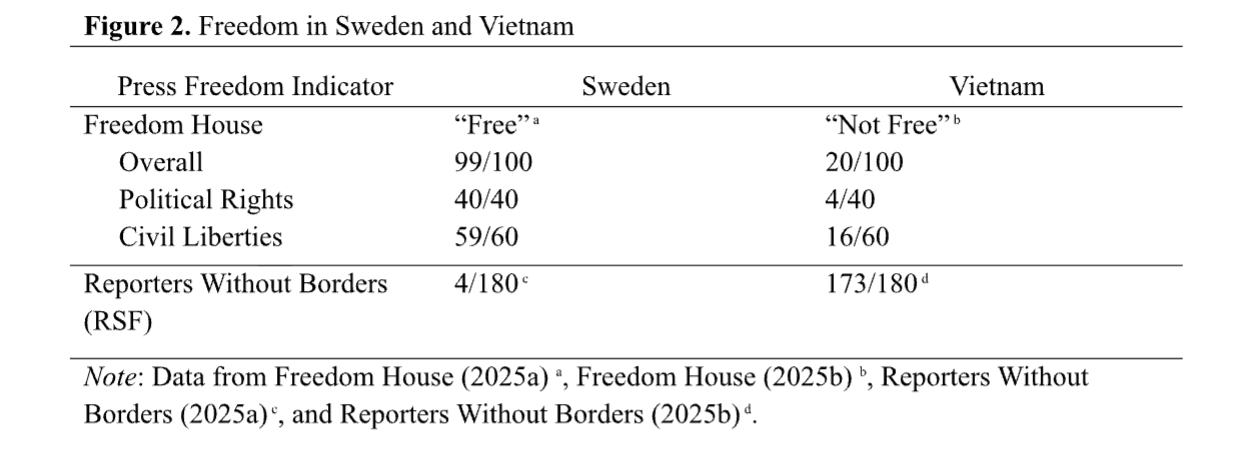
As shown in Figure 2, Sweden ranks significantly high on both freedom indices. In contrast, Vietnam ranks low on both freedom indices.
Conclusions and Discussion
This comparative case study of Sweden and Vietnam has illustrated that state intervention has a key role in shaping their media systems, as well as the levels of press freedom. While both countries exhibit state intervention methods, the extent and impacts of their interventions differ drastically. This is also reflective of their contradicting political regimes.
In Sweden, state intervention is characterized by primarily protective interventions. Public broadcasting in Sweden is widespread and mostly free of political and commercial influence. State subsidies in Sweden are designed to reduce market inequalities, protect access to information, and promote local journalism. Regulations in Sweden are administered by independent agencies. Sweden is considered a leader in digital infrastructure. Lastly, the government does not impose any outright censorship on the media. These interventions function to enhance the media system and press freedom in Sweden. These insights are also supportive of Sousa and Fidalgo’s (2011) argument that state regulation and intervention can have positive effects on press freedom in democratic contexts.
In Vietnam’s media system, state intervention is used for control, suppression, and shaping public opinion in favor of party ideology. While government subsidies and investments in digital infrastructure exist and may positively impact the media environment, these
mechanisms are used primarily to reinforce the state’s ideology, rather than promote independent journalism. Public broadcasting does not exist effectively as political parties influence it, regulations are centralized within the government’s ministry, and censorship is harsh. The data collected on Vietnam aligns with Stier’s (2015) and Albuquerque’s (2022) observations on state intervention and regulation serving as repressive mechanisms on press freedom within autocratic regimes, particularly single-party autocracies.
The findings on both countries work together to support this paper’s argument that state intervention has a substantial impact on press freedom, which is also heavily influenced by the regime. In liberal democracies like Sweden, intervention positively impacts press freedom, while the opposite is true for single-party autocracies like Vietnam. This case study also further demonstrates the limitations of the Stage of Democracy Development (SDD) model addressed by Albuquerque (2022). This research illustrates how the SDD model may not fully account for nuanced variations in state intervention across non-Western media systems. Therefore, this research contributes to the growing call for a more inclusive and context-sensitive approach to classifying regime types in media systems scholarship.
This research, however, is subject to three major limitations. First, the study is constrained by the availability and transparency of data and information, especially in the case of Vietnam. Due to Vietnam’s strict state control over information, access to accurate or up-to-date statistics was limited. This may result in an incomplete, limited, or skewed analysis of Vietnam’s media system. Second, the reliance on secondary sources, such as governmental reports, academic literature, and freedom indices, may contribute to bias from differing standards and potential political motivations. For example, freedom indices, like Freedom House and Reporters Without Borders, may contain bias reflecting Western liberal norms. Lastly, this comparative analysis was a selection of only two countries, which limits the generalization of the findings. The selection of countries on polarized ends of the press freedom spectrum provides valuable insight but may not reflect the nuances of hybrid regimes.
References
Becker, L. B., Vlad, T., & Nusser, N. (2007). An Evaluation of Press Freedom Indicators. The
International Communication Gazette, 68(1), 5-28.
https://doi.org/10.1177/1748048507072774
Chuc, N. D., & Anh, D. T. (2023). Digital Transformation in Vietnam: Policies, Results and
Recommendations. Journal of Southeast Asian Economies, 40(1), 127–144.
https://www.jstor.org/stable/27211227
De Albuquerque, A. (2022). Transitions to nowhere: Western teleology and regime-type
classification. The International Communication Gazette, 85(6), 479-497.
https://doi.org/10.1177/17480485221130220
European Platform of Regulatory Authorities. (2024, January 9). The Swedish Agency for the
Media: Merger of the MPRT and the SMC. https://www.epra.org/news_items/the- swedish-media-authority-merger-of-the-mprt-and-the-
smc#:~:text=Merger%20of%20the%20two%20Swedish,promotion%20unit%20/%20the
%20administration%20unit
Freedom House. (2025). Sweden. https://freedomhouse.org/country/sweden
Freedom House. (2025). Vietnam. https://freedomhouse.org/country/vietnam
Gustafsson, K. E., Örnebring, H., & Levy, D. A. L. (2009). Press Subsidies and Local News: The
Swedish Case. Reuters Institute for the Study of Journalism 1-22.
https://reutersinstitute.politics.ox.ac.uk/our-research/press-subsidies-and-local-news-
swedish-case
Hallin, D. C., & Mancini, P. (2004). Comparing Media Systems: Three Models of Media and
Politics. Cambridge University Press.
Hallin, D. C., & Mancini, P. (2017). Ten Years After Comparing Media Systems: What Have We
Learned?. Political Communication, 34, 155-171.
https://doi.org/10.1080/10584609.2016.1233158
Huyen, N. T. N., & Trung, B. C. (2019). The state management of media activities in Vietnam.
Russian Journal of Vietnamese Studies, 3(3), 18-27. https://doi.org/10.24411/2618-9453-
2019-10024
International Trade Administration. (2024, September 20). Sweden Country Commercial Guide.
https://www.trade.gov/country-commercial-guides/sweden-digital-economy
Jakobsson, P., Lindell, J., Stiernstedt, F. (2021). A Neoliberal Media Welfare State? The Swedish
Media System in Transformation. Javnost – The Public, 28(4), 375-390.
https://doi.org/10.1080/13183222.2021.1969506
Kamali, M. (2021). Securitisation and Self-Censorship in Mainstream Media. In: Neoliberal
Securitisation and Symbolic Violence. Palgrave Macmillian. https://doi.org/10.1007/978-
3-030-71210-5_4
Mattoni, A., & Ceccobelli, D. (2018). Comparing hybrid media systems in the digital age: A
theoretical framework for analysis. European Journal of Communication, 33(5), 540-557.
https://doi.org/10.1177/0267323118784831
Ministry of Information and Communications. (2022). Functions and Duties.
https://english.mic.gov.vn/introduction/functions-and-missions-of-mic
Ministry of Science and Technology. (2024, October 10). Digital infrastructure strategy
approved. https://english.mic.gov.vn/digital-infrastructure-strategy-approved-
197241010150835947.htm
Reporters Without Borders. (2025). Sweden. https://rsf.org/en/country/sweden
Reporters Without Borders. (2025). Vietnam. https://rsf.org/en/country/vietnam
Schrøder, K. C., Blach-Ørsten, M., & Kæmsgaard Eberholst, M. (2020). Is There a Nordic Media
System? A descriptive comparative analysis of Nordic news audiences. Nordic Journal of
Media Studies, 2, 23-35. https://www.doi.org/10.2478/njms-2020-0003
Sousa, H., & Fidalgo, J. (2011). Journalism Regulation: State Power and Professional Autonomy.
In The Handbook of Political Economy of Communications (pp. 331-353). Wiley-
Blackwell. https://doi.org/10.1002/9781444395402.ch13
Stier, S. (2015). Democracy, autocracy and the news: the impact of regime type on media
freedom. Democratization, 22(7), 1273–1295.
https://doi.org/10.1080/13510347.2014.964643
Sveriges Radio. (2020). Our channels. https://www.sverigesradio.se/artikel/733463
SVT. (2025). About SVT. https://omoss.svt.se/about-svt.html
The World Factbook. (2025). Sweden. https://www.cia.gov/the-world-
factbook/countries/sweden/
The World Factbook. (2025). Vietnam. https://www.cia.gov/the-world-
factbook/countries/vietnam/
Trade Commissioner Service. (2025). Information and Communications Technologies (ICT)
market in Sweden. https://www.tradecommissioner.gc.ca/sweden-suede/market-reports-
etudes-de-marches/0007492.aspx?lang=eng
Tran, H. D., & Diep, P. P. U. (2024). Investigating the relationship between knowledge of the
media industry and media trust in a government-owned and government-controlled media
system. Communication and the Public, 1-21. https://doi.org/xxxxx
United Nations Educational, Scientific and Cultural Organization. (2020). Media subsidies.
https://www.unesco.org/creativity/en/policy-monitoring-platform/media-subsidies
United Nations. (1948). Universal Declaration of Human Rights. Retrieved from
https://www.un.org/en/about-us/universal-declaration-of-human-rights
UR. (2025). About UR. https://www.ur.se/om-oss/about-ur/
Weibull, L., & Börjesson, B. (1992). The Swedish Media Accountability System: A Research
Perspective. European Journal of Communication, 7(1), 121-139.
https://doi.org/10.1177/0267323192007001006
Weibull, L., & Wadbring, I. (2010). Scandinavian States: Media Systems. The International
Encyclopedia of Communication. http://dx.doi.org/10.1002/9781405186407.wbiecs010
Joshua Farrell
A Cross-National Comparison Between Media Systems in South Africa and China
Joshua Farrell
Introduction
South Africa and China represent countries with two distinctively different political, economic, and media landscapes. South Africa, since the fall of apartheid in 1994, has transitioned into a constitutional democracy with a vibrant, although occasionally contested, commitment to press freedom. The country’s media landscape includes a mix of public broadcasters, private outlets, and independent platforms which seek to serve the democratic role of journalism as watchdogs of the government. The South African constitution protects freedom of expression and freedom of the media, and despite political pressures (Wasserman, 2017), the press has retained a robust investigative tradition. However, several challenges exist, including financial instability within the journalism industry and periodic governmental interference. China, on the other hand, operates under an authoritarian regime where the ruling Communist party exerts substantial control over the flow of information. The Chinese media system is tightly
monitored and regulated, functioning more as a mouthpiece for the government rather than as an adversary. Even though technological advancements have expanded digital media platforms and made it easier for individual opinions to reach a broad audience, these spaces are still heavily censored. The Chinese government views media not as a forum for public debate, but as an extension of the party’s ideological and political goals. This stark difference from the South African model underscores the complexity of comparing and understanding the media dynamics
between the two nations. Within the international media, China has long sought to influence the narrative about itself as
part of a broader strategy to manage its global image and counter what it perceives as negative
portrayals by the Western media. This effort is rooted in the Chinese government’s desire to position itself both as a major world player and as a responsible global actor, especially amid growing international scrutiny (Olorunnisola and Ma, 2013). While criticism from Western media outlets is not new, it significantly intensified during the 2008 Beijing Summer Olympics. The global spotlight during the 2008 games brought widespread attention not only to China’s
economic rise but also to controversial issues such as its troubling human rights record, environmental concerns surrounding the worsening smog problem, and the government’s handling of internal dissent. Western outlets published a wave of critical coverage, painting the event as a symbol of China’s authoritarianism rather than its vast economic growth (Umejei 2018).
In response to this barrage of negative press and subsequent reputational damage, China began seeking out external partnerships and investments in foreign media markets, particularly in regions where Western influence was less prevalent. This led to the rise of the journalistic and economic partnership between China and South Africa. In the years that followed, China has become one of the leading investors in South African infrastructure, devoting substantial
resources in South African media institutions, journalist training programs, and media content exchanges (Madrid-Morales and Wasserman, 2017). Despite the philosophical differences of their governments- South Africa as a democracy and China as an authoritarian state, the two countries have developed a deep institutional partnership.
While diplomatic ties between the two countries first originated in 1998, the journalistic partnership between the two countries quickly gained steam within the 2010’s, shortly after the fallout from the 2008 Beijing Summer Olympics (Shinn and Eisenman, 2024). In 2010, China invited South Africa to join the BRIC alliance (now the BRICS), an alliance comprising of several countries (most prominently Brazil, Russia, India, China, and now, South Africa) seeking
to collectively increase their economic growth (Wasserman, 2013b). This signaled the growth of the Chinse-South African relationship and established South Africa as a major economic leader on the African continent. In 2013, the Chinese Central Television Network (CCTV) participated in the acquisition of Independent Media (South Africa’s leading multi-platform content company) with Dr. Iqbal Survé, an investor with relations to the African National Congress,
South Africa’s ruling party (Wasserman, 2017). These developments not only reflect the strengthening of economic and diplomatic ties between China and South Africa but also mark the beginning of a deeper ideological and media collaboration. By investing in South African media infrastructure and aligning with influential political figures, China has positioned itself to exert influence over the narratives being produced and disseminated within the country. This growing journalistic partnership suggests a deliberate strategy by China to extend its media model and
global communication footprint. This article aims to explore the similarities and differences between the media systems of South Africa and China. Drawing upon research and the theoretical framework from Hallin and
Mancini’s Comparing Media Systems (2004), this article will focus in particular on the media marketing and state intervention of both countries. By comparing the structure, function, and values underpinning each country’s media system, this paper will examine how political ideology, regulatory frameworks, and economic interest shape the media operations and press freedom. Ultimately, this analysis seeks to contribute to a broader understanding of global media
dynamics in an era of shifting geopolitical influence.
Literature Review/Theoretical Framework
Given that the Chinese engagement in South Africa has spanned for over a decade, a growing body of literature and journalistic articles have emerged to assess the implications of this partnership. These works present a diverse range of perspectives- some highlighting the mutual benefits and opportunities the partnership offers, while others raise concerns about the long-term effects that this partnership has on the journalism industry. Many of these studies directly included journalists from South Africa to better understand their perceptions of Chinese
influence and the nature of the media partnership. Wasserman and Madrid-Morales (2017) interviewed twenty journalists in one of these studies to learn how South African media professionals engage with Chinese media content and how they perceive its influence on local journalism. At the conclusion of this study, they were able to
separate the common attitudes of journalists into four different profiles: adopters, resisters, pragmatists, and unconvinced. In the end, they found that the common opinion amongst journalists interviewed was that the impact of the Chinese news media on the journalistic profession in Africa is perceived to be low.
In a similar study, Umejei (2018) interviewed thirty South African journalists who were separated into three different groups based on their experience levels. This study focused primarily on positive reporting; the editorial policy instilled by Chinese media organizations in South Africa that focuses on reporting feel-good stories over critical or depressing headlines. The results from this study were extremely mixed, both on the aggregate and amongst the three
experience groups. Many journalists appreciated the change of pace brought about by positive reporting in a news world that often highlights negativity and controversiality. Others believe that positive reporting limits journalists from holding the government accountable and being able to perform their role as a watchdog of the government.
Scholars offer differing interpretations of the Chinese government’s motivations for its partnership with South Africa. Kurlantzick (2007, apud Wasserman, 2013a) describes China’s strategy as a ‘charm offensive’- a deliberate effort by China to enhance its international image and appeal by investing in media and culture. On the other hand, Shi (2013, apud Wasserman, 2013a) proposes the concept of a ‘charm defensive’ approach, arguing that China’s actions are
less about building a positive reputation in international audiences but more of a counter to the negative portrayals it receives in the media. Furthermore, Olorunnisoa and Ma (2013) identified four historical factors that play into China’s media approach in South Africa: imbalanced relationships between Africa and the western world, China’s internal and global challenges in constructing its ‘grand strategy’, the future of the African continent, and competition between
China and the United States of America. One of the key terms used across multiple pieces of literature to characterize China’s involvement in South African journalism is soft power. Joseph Nye, author of Soft Power: The Means to Success in World Politics, defines soft power as ‘the ability to get what you want through attraction rather than coercion of payments’ (2004, apud Wasserman, 2013a). In this context, China’s use of soft power is evident in its investments in local media infrastructure, training programs for journalists, and content sharing agreements- all of which are designed to foster a more favorable image of China to counteract what is perceives as biased coverage from the Western media. Many Africans view China’s soft power strategy as healthy competition with the West over trade, investment, and cultural influence that will ultimately benefit South Africa’s economic and developmental growth (Umejei, 2018). Others have raised suspicions, however, that the strategy is just a front by China to gain power and impact over an area of the world that is more susceptible to subtle influence (Olorunnisola and Ma, 2013). A foundational theoretical lens for this study is provided by Hallin and Mancini’s Comparing Media Systems (2004), which categorizes media systems into different models based on four key dimensions: political parallelism, media market, state intervention, and journalistic
professionalism. This paper builds upon Hallin and Mancini’s framework by using it as a comparative baseline to analyze the media environments of South Africa and China. Despite the framework including four media dimensions, this article will primarily focus on the media market and state intervention dimensions given their importance and relevance within the context of the South Africa-China media relationship. By examining how these divergent media systems interact through their institutional partnership, this paper aims to contribute to the growing
literature that seeks to adapt and expand Hallin and Mancini’s theoretical framework. In Comparing Media Systems, Hallin and Mancini define the media markets dimension by measuring how media is consumed and the size of media audiences, including looking at newspaper circulation and audience orientation. They define the state intervention dimension by studying the extent to which the state intervenes into the country’s media system, including
media regulation and censorship or political control. However, since the release of Comparing Media Systems in 2004, there have been several attempts to redevelop or redefine the framework. Brüggemann and colleagues (2014, apud Hallin and Mancini, 2016) defined state intervention by three different elements: strength of public service broadcasting, press subsidies, and ownership regulation. They also listed several other indicators of state intervention that include regulation of journalistic practice, regulation of content, and right of reply and hate-speech laws. Similarly,
Voltmer (2013, apud Hallin and Mancini, 2016) notes that the relationship between the media system and the economy is an indicator of the media markets dimension.
Methods
This paper adopts a comparative approach, using both qualitative and quantitative data, in an attempt to analyze the South African and Chinese media systems. It is grounded in the theoretical framework developed by Hallin and Mancini in Comparing Media Systems. While Hallin and Mancini identify four key dimensions in their framework, this paper will focus specifically on the media market structure and the state intervention dimensions. Within these dimensions, this
paper will focus specifically on regulatory laws and media ownership, as well as how online forms of media including social media, digital broadcasting, and online publications factors into each country’s media landscape. These dimensions are particularly relevant to understanding the Chinese-South African media relationship given the contrasting roles that the state plays in each county’s media environment as well as the ways in which media markets are shaped by political and economic forces. By examining these two dimensions, this paper aims to uncover how China’s strategic engagement in the South African media may influence or challenge the country’s media autonomy, market dynamics, and journalistic trends. Rather than conducting original fieldwork or interviews, this study is a review and synthesis of existing academic articles, studies, and reports that have analyzed both the Chinese and South
African media systems at the individual level and in connection with one another. It compiles data from a range of peer-reviewed journal articles, case studies, and institutional reports that focus on the structural characteristics of the media systems in both countries, as well as the nature and effects of Chinese involvement in South African journalism.
This method allows for a broader contextual analysis of trends and patterns that have persisted over time, particularly those emerging since the early 2010’s, when the China-South Africa media partnership began to intensify. Through this comparative review, this article seeks to contribute to the growing body of research on global media influence and how different political systems impact journalism. This article does not attempt to make definitive causal claims about
China’s impact on South African media but instead aims to highlight key areas of research that warrant deeper investigation.
Results
Media Markets
The Chinese media market contains several state-owned media outlets and applications that are regulated in accordance with the government’s strict speech and content policies. China Central Television Network (CCTV) is the largest and most influential news broadcaster in the country (Zhou, 2015). As a state-owned entity, CCTV functions as one of the government’s primary tools for disseminating official news and information. It has established business relations with over 250 television organizations in more than 130 countries, and even has an office in Nairobi, the
capital of Kenya, giving it significant reach and influence on both the African continent and around the world (Wasserman, 2013a). Xinhua is the nation’s official news agency, and with its high amount of resources and funding, it is relied upon by many Chinese newspapers for international news stories. The social media landscape in China is similar to that of the rest of the world, but it is dominated by homegrown platforms due to strict government regulations. Many of the world’s most popular social media apps around the world are banned in China, including YouTube, Facebook, and X (Thomala, 2025). In their place, domestic platforms have thrived, with WeChat being the most widely used. WeChat is a multifunctional app that integrates features commonly found across several Western apps into a single platform. It functions primarily as a social networking tool- offering text messaging, phone calling, and photo sharing, but also includes services like ridesharing, food delivery, mobile payment, and ecommerce (Cao, 2022). With over a billion users, WeChat is deeply embedded in everyday life in China and serves as both a social and
commercial hub for its citizens, all while operating under strict government surveillance. Another influential app, Weibo, can be best described as the Chinese version of X. It has over 250 million users and allows word posts between 140 and 2,000 Chinese characters (Thomala, 2025).
In contrast to China’s tightly regulated social media landscape, the social media environment is much more open in South Africa, with unrestricted access to major international platforms like YouTube, X, and the Meta apps (Facebook, Instagram, WhatsApp) (Cowling 2025). The most used social media app in South Africa is WhatsApp, with a 93.9% share of internet users in the third quarter of 2023 (see Figure 1) (We Are Social, 2024). Although there are significantly
fewer social media users in South Africa than in China, the South African social media landscape is highly effective in that it facilitates widespread communication and often plays a role in social movements. While the social media market in South Africa is advanced and globally integrated, the broader media landscape continues to reflect the challenges of relatively late development. One significant barrier is language diversity. South Africa has 11 official languages, which are not always equally represented, making it extremely difficult for those who speak the non-dominant languages to consume media. Although over 10 million households have electricity, just 7.76 million households owned a TV, restricting traditional media reach from a large portion of the population (Berger, 2010). Additionally, despite South Africa having the highest quality of internet connectivity on the continent, access remains uneven (Investment Monitor, 2021). The high cost of installing home internet systems makes it inaccessible for many, leaving large portions of the population dependent on public internet access points- many of which suffer from
slow and unreliable service.
State Intervention
State intervention in the South African media system is marked by a general respect for press freedom, though political influence can occasionally give rise to corruption. The fall of apartheid in 1994 brought about the adoption of a democratic government, and in 1996, a new Constitution of South Africa was written, which enshrined freedom of speech and freedom of the press as fundamental rights.
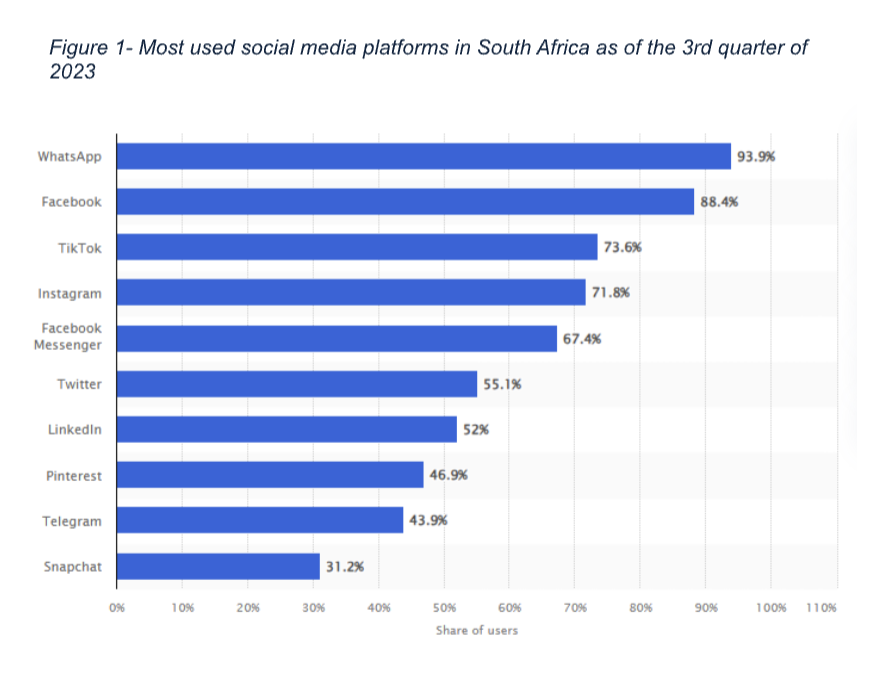
These developments laid the foundations for a media system with relatively high levels of press freedom. From 2022-2024, South Africa consistently ranked near the top of African countries on the Press Freedom Index, with scores ranging between 73.3 – 78.6 out of 100 in all three years (Reporters Without Borders, 2024). In general, the media operates independent of the government and serves as a watchdog to hold the government accountable. This, however, does not always hold up in practice. South African media companies are not immune from undue influence and from the spread of dishonest and ‘fake’ news. One instance of this occurred when the Gupta family, a rich and powerful family accused of colluding with South African President Jacob Zuma, hired a PR firm to create a ‘white monopoly capital’ narrative that painted Zuma and his supporters as the victims of white racism. This led to the creation of hundreds of fake Twitter accounts with the sole purpose of spreading this narrative (Wasserman, 2017). So, while the government, and those in power, do not have direct influence in controlling the content the media produces, they are able to manipulate their power to control the opinions and the narratives that are created. In comparison to the Chinese state intervention in the media, the South African state is much more lenient to the press. China operates under an authoritarian communist regime, and the press is heavily controlled and seen more as an instrument for state messaging. There are several governmental news agencies in China. The State Administration of Press, Publication, Radio, Film, and Television of the People’s Republic of China (SAPPRFT) is responsible for enforcing China’s press regulations and the General Administration of Press and Publication (GAPP) is responsible for screening content for potential censorship. Additionally, China has several government sponsored news organizations, including Xinhua News Agency, China’s official news agency, China Central Television (CCTV), and China Radio International (CRI) (Zhou,
2015). China is generally seen among the rest of the world as one of the most restrictive governments in terms of press freedom. On the Press Freedom Index, China received scores between 22.97 and 25.17 out of 100 from 2022-2024, roughly 50 points lower than South Africa within that same period (See Figure 2) (Reporters Without Borders, 2025). Additionally, according to data from the Committee to Protect Journalists, China has 44 journalists who are currently jailed for media infractions, a number that is the largest amongst all countries in the world and is likely understated given the difficulty in tracking this data (Fleck, 2025).
Discussion
One of the key trends that has emerged from this research is that the South African and Chinese media systems exhibit far more differences than similarities. These differences are rooted in the contrasting political ideologies and governmental structures that shape each country’s philosophy on the role of the media. China, governed by an authoritarian regime, views the media primarily as an agent of the state, responsible for promoting official narratives and maintaining political stability. In contrast, South Africa, as a constitutional democracy, regards the media as a
watchdog of the government, responsible for promoting transparency and holding those in power accountable. These philosophical differences have resulted in South Africa ranking among the freest media systems on the African continent, while China continues to operate as one of the most tightly controlled and censored media environments in the entire world. Despite these fundamental differences, South Africa’s media system remains largely independent
of Chinese influence. While China maintains strict regulations over its own media, it does not extend those limitations to South African outlets as one of the criteria for their media relationship to exist. South African journalists are free to publish content that may be critical of China or its
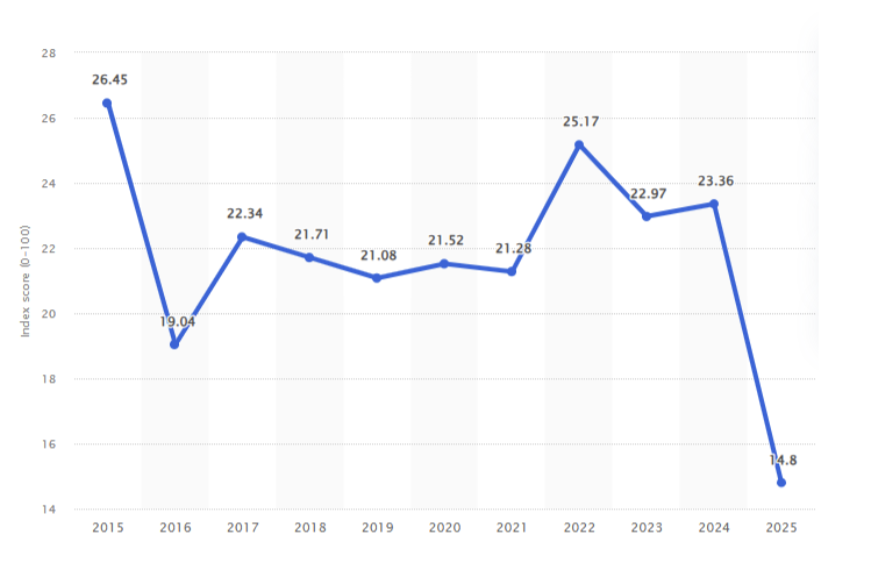
government without fear of censorship. Additionally, China does not impose any restrictions on South African social media content, as evidenced by the stark differences in which social media apps are used between the two countries. This unrestricted media environment allows for South Africa to maintain its own distinct media system and its citizens to engage with both local and international news without the censorship of surveillance seen in China. As a result, South Africa retains full editorial sovereignty in its media reporting, even while maintaining a cooperative
relationship with China. Meanwhile, the media partnership between the two countries continues to function smoothly and is mutually advantageous for both sides. China has invested in several areas of South Africa’s media landscape, including journalist training programs, content distribution systems, and infrastructure development. These initiatives help strengthen South Africa’s media capabilities and create new professional growth opportunities for journalists. In return, South Africa offers China access to African audiences and broadcasting markets, which expands the global reach of Chinese state media and enhances China’s soft power influence and agenda. This also allows
China to have more control over the media narrative of its own country in hopes of changing its perception among the rest of the world. Despite operating under vastly different media philosophies, the two countries have found a way to coexist and benefit from their collaboration without sacrificing South Africa’s media freedom. Although the apparent benefits of the China-South Africa media partnership are evident, there are notable limitations in the existing research that make it difficult to draw firm conclusions about its long-term impact. One major challenge is that there is conflicting data surrounding whether South Africa’s journalistic industry has been significantly influenced by Chinese
involvement. There are plenty of surveys that have been conducted with South African journalists inquiring on this topic, however there is not a definitive consensus among journalists, and many different opinions on this topic exist. Moreover, there is a lack of long term, comprehensive data to assess whether this partnership is truly equitable or if it disproportionately benefits China in the broader geopolitical context. One of South Africa’s primary concerns
regarding the relationship with China is whether the benefits of the partnership are fairly distributed, which is exacerbated by a long history of western countries abusing partnerships with African countries. Most available research only focuses on short term outcomes, primarily due to the relative youth of the partnership, leaving an incomplete picture of the success of the relationship. Future studies should seek to develop metrics to assess the trends and patterns of both countries’ media systems to evaluate the success of the partnership. In conclusion, while South Africa and China maintain a collaborative and strategically beneficial media partnership, they continue to operate under vastly different media philosophies. South Africa’s ability to preserve press freedom in this relationship reflects its strong institutional commitment to democratic principles, while China’s soft power approach is evident in its
collaboration and efforts to shape international perceptions through media engagement. Nonetheless, the long-term effects remain uncertain, and future research is needed to determine whether this partnership will continue to serve the interests of both countries.
References
Berger, G. (2010). South Africa: Media system. The International Encyclopedia of
Communication. https://doi.org/10.1002/9781405186407.wbiecs078
Brüggemann, M., Engesser, S., Büchel, F., Humprecht, E., & Castro, L. (2014). Hallin and
Mancini revisited: Four empirical types of western media systems. Journal of
Communication, 64(6), 1037–1065. https://doi.org/10.1111/jcom.12127
Cao, H. (2022). Organizing an “organizationless” protest campaign in the wechatsphere. Big
Data & Society, 9(1). https://doi.org/10.1177/20539517221078823
Cowling, N. (2025, April 14). Social media in South Africa - statistics & facts. Iowa City.
Retrieved April 26, 2025.
Fleck, A. (April 30, 2025). Number of Jailed Journalists Remains High [Digital image].
Retrieved May 12, 2025, from https://www-statista-
com.proxy.lib.uiowa.edu/chart/16414/jailed-journalists-timeline/
Hallin, D. C., & Mancini, P. (2004). Comparing Media Systems. Cambridge University Press.
Hallin, D. C., & Mancini, P. (2016). Ten years after comparing media systems: What have we
learned? Political Communication, 34(2), 155–171.
https://doi.org/10.1080/10584609.2016.1233158
Investment Monitor. (November 15, 2021). African e-Connectivity Index 2021 [Graph].
In Statista. Retrieved May 12, 2025, from https://www-statista-
com.proxy.lib.uiowa.edu/statistics/1308940/countries-with-highest-quality-of-internet-
connectivity-in-africa/MM
Kurlantzick, J., & Hirst, P. (2007). Charm offensive: How China’s Soft Power is transforming the
world. Yale University Press.
Madrid-Morales, D., & Wasserman, H. (2017). Chinese media engagement in South Africa.
Journalism Studies, 19(8), 1218–1235. https://doi.org/10.1080/1461670x.2016.1266280
NYE, J. S., Jr. (2004). Soft power: The means to success in world politics. Public Affairs.
Olorunnisola, A., & Ma, L. (2013). Contemporary Sino-African relations: Interpenetration of
history of relations with the West, ideology and comparative media frames. Ecquid Novi:
African Journalism Studies, 34(3), 41–61. https://doi.org/10.1080/02560054.2013.845590
Reporters Without Borders. (May 2, 2025). Press freedom index in China from 2015 to 2025
[Graph]. In Statista. Retrieved May 12, 2025, from https://www-statista-
com.proxy.lib.uiowa.edu/statistics/1117177/china-press-freedom-index/
Reporters Without Borders. (May 5, 2024). Press freedom index in Africa from 2022 to 2024, by
country [Graph]. In Statista. Retrieved May 12, 2025, from https://www-statista-
com.proxy.lib.uiowa.edu/statistics/1221101/press-freedom-index-in-africa-by-country/
Shi, A. (2013). Strategies and objectives to attract new audiences abroad. Paper presented at the
FoME Symposium ‘Promoting Alternative Views in a Multipolar World: BRICS and
their role in Developing Media Markets, Berlin, 10 October.
Shinn, D. H., & Eisenman, J. (2024). China’s relations with Africa a new era of strategic
engagement David H. Shinn Aut; Joshua Eisenman Aut. Columbia University Press.
Thomala, L. L. (2025, February 20). Social media in China - statistics & facts. Iowa City.
Retrieved April 26, 2025.
Umejei, E. (2018). Hybridizing journalism: Clash of two “journalisms” in Africa. Chinese
Journal of Communication, 11(3), 344–358.
https://doi.org/10.1080/17544750.2018.1473266
Voltmer, K. (2013). The media in transitional democracies. Polity.
Wasserman, H. (2013a). China in Africa: The implications for journalism. Ecquid Novi: African
Journalism Studies, 34(3), 1–5. https://doi.org/10.1080/02560054.2013.861955
Wasserman, H. (2013b). South Africa and China as BRICS partners: Media Perspectives on
geopolitical shifts. Journal of Asian and African Studies, 50(1), 109–123.
https://doi.org/10.1177/0021909613514191
Wasserman, H. (2017). Fake news from Africa: Panics, politics and Paradigms. Journalism,
21(1), 3–16. https://doi.org/10.1177/1464884917746861
We Are Social, & Hootsuite, & DataReportal. (February 23, 2024). Most used social media
platforms in South Africa as of the 3rd quarter of 2023 [Graph]. In Statista. Retrieved
May 12, 2025, from https://www-statista-
com.proxy.lib.uiowa.edu/statistics/1189958/penetration-rate-of-social-media-in-south-
africa/
Zhou, S. (2015). China: Media system. The International Encyclopedia of Communication.
https://doi.org/10.1002/9781405186407.wbiecc022
Kennedy Lein
Author: Kennedy Lein
Moving Past the Language: A Comparison of Spain and Argentina’s Media Systems.
Introduction
Despite sharing languages, media systems are often not congruent with each other in other countries, specifically Spain and Argentina, both Spanish-speaking countries. These two countries exhibit diverse media systems that are shaped through political and economic contexts. Spain is represented by the European government-structured and regulated model (Barrera, 2010), whereas Argentina reflects a Latin American system that focuses on a politically driven media system (Kitzberger, 2022). It is important that we take time to research and analyze how countries that do not experience a language barrier still have different ways in which economic and political ideologies and regulations play into their media systems. This essay aims to compare how political and economic factors shape media systems in Spain and Argentina to explore an understanding of media regulation, ownership, and press freedom. My main question
is, how do political and economic factors shape media systems in Spain and Argentina, and what similarities and differences exist in their media regulation and press freedom? Through news outlets and regulation websites, this paper outlines the key similarities and differences of each country’s media system, tapping into the work of previous scholars and comparing how these media systems do or don’t align with existing global media theories.
Theoretical Framework/Literature Review
This comparative analysis draws from previous scholars Daniel Hallin and Paolo Machini, who co-wrote Ten Years After Comparing Media Systems: What Have We Learned? In 2012. This literature article is important to look at because Hallin and Mancini believed that
media systems go beyond just language and culture, but instead through categories like economics and politics. The authors suggested four dimensions in order to compare 18 different countries.
- The Development of Media Markets: The emphasis on the development of mass-circulation press.
- Political Parallelism: the extent to which the media system reflects, aligns, or supports political parties and ideologies in society.
- The Characteristics of Journalistic Professionalism: the understanding of values and practices that outline journalism as a profession. Furthermore, the understanding of fact-based or opinionated journalism.
- The Degree and Nature of State Intervention: refers to how much of a role the government plays in influencing, regulating, and supporting media systems.
The authors claimed that if there was a clear understanding of these four dimensions, then there could be a creation of three new categories. These models include:
- Democratic Corporatist: refers to a high level of journalistic professionalism, a well developed and widespread press, and governmental support and regulation of media, alluding to strong state intervention.
- The Polarized Pluralist: refers to when countries have similar political agendas and models.
- Liberal Model: a system where the press is usually privately owned, journalists aim to stay objective, the media isn’t heavily influenced or used by political groups, and there is little control from the government.
Though Hallin and Mancini support good research, their work is flawed. They leave out 180 other countries and instead focus on 18 rich, western countries. Therefore, this research misses the opportunity to include other countries that are outside the Western media lens. Other scholars like Alice Mattoni, the author of Comparing hybrid media systems in the digital age: A theoretical framework for analysis, and Alfonso Albuquerque, Transitions to nowhere: Western teleology and regime-type classification, have criticized Hallin and Mancini, offering new perspectives when comparing non-Western media systems. This criticism suggests adaptations for new media systems and new indicators and parameters for the four dimensions that better adapt to non-Western media systems. This will be taken into account while comparing Spain and Argentina to this theoretical framework and discussion. This literature review is still relevant to this comparative analysis because Spain and Argentina's media systems can be classified within Hallin and Mancini’s argument. Spain and
Argentina align directly with the Polarized Pluralist Model, but Spain is also considered to be associated with what is called the Mediterranean model (Hallin, Mancini, 2017). Spain and Argentina also fit into the four dimensions. However, these criticisms will be taken into account and balanced with other scholars who have suggestions.
Methodology
This comparative analysis will focus on a qualitative analysis approach that aligns with Hallin and Mancini’s four-dimensional concepts for comparing and analyzing media systems. To demonstrate good comparisons, this essay looks into both primary and secondary sources, such as right and left-leaning news outlets, government regulation sites, and other academic sources that are relevant to this essay.
The primary research of this essay will look into two major news outlets from each country, eliminating bias by analyzing two with different political agendas and leanings. For Spain, El País is left-leaning and El Mundo is right-leaning, according to NYU Madrid. For
Argentina, Página12 is left-leaning and La Nación is right-leaning, according to the BBC News and What Argentina. In addition to this primary research, this essay will also delve into media regulation by examining each country’s media regulation sites. For Spain, CNMC, and for Argentina, ENACOM. This is included to help better understand the governmental power that is held over the media systems of these countries and how they affect reporting. Secondary research will be introduced through two main academic articles, “Spain: Media
System” written by Carlos Barrera, and “Media-Politics Parallelism and Populism/Anti-populism Divides in Latin America: Evidence from Argentina” by Philip Kitzberger. These two academic research articles pave the way for my research comparison of these two countries because they supply a basis of information on how both media systems operate. These two pieces are relevant in understanding media ownership, regulation, and political and economic factors that contribute to each. Other academic articles will be presented throughout the research if found relevant. Additionally, websites like Reporters Without Borders are referenced in understanding press freedom indexes.
Overall these methods better outline how Spain and Argentina fall into the categories of Hallin and Mancini, focusing on the four key dimensions and models. The research analysis will also attempt to offer critiques about Hallin and Mancini’s research.
Results
This comparative analysis of Spain and Argentina, grounded in Hallin and Mancini’s framework and models, reveals how media systems heavily reflect upon political and economic structures. The results look deeply into the four dimensions, but also the three models Hallin and Mancini propose, and how Spain and Argentina fit into each of them.
The Development of Media Markets
As previously stated, the development of media markets according to Hallin and Mancini refers to mass-circulation press and whether or not a country has access to a widespread, influential press. Hallin and Mancini categorize the development of media markets through press readership, therefore, TV news is not included in the research (Hallin and Mancini, 2004). When looking into Spain’s media system, Hallin and Mancini stated in 2004 that Spain had a low-circulation press, showing little development of the media market. In 2008, Spain ranked ninth in the world in GDP (gross domestic product), referring to a more developed media market (Barrera, 2010). In 2023, according to Worldometers, Spain ranked 15th, at 1.62 trillion. Though Spain is among one of the largest and strongest economies in the world, it has a low circulation of Spanish newspapers because of the interest in TV and broadcast media (Hallin and Mancini). The two news outlets this research comparison focuses on, El País and El Mundo, are both national presses (Barrera, 2010). According to Statista, newspaper readership has fallen 13.7% in 2023. Though, in 2008, newspaper readership peaked to 42% (Statista). This shows a large decline in widespread printed press in Spain, leading to a low circulation of press. However, there was an 81.9% rise in daily TV viewership in 2023 (Statista).
In Argentina, print newspapers and magazine usership is projected to decline by 16.7% by 2029, a 8 million user decline (Statista). Argentina’s economy ranks just under Spain at 22nd ( Worldometers ), but also has a widespread media market, though it is very concentrated (Mastrini, Espada, 2024). Clarín dominates as a media outlet, but La Nación stands among the popular news outlets (Mastrini, Espada, 2024). While comparing these two countries, it is interesting to see stable economies have low-ranging media markets because of the way Hallin and Mancini categorized them.
Spain and Argentina Online News Viewership
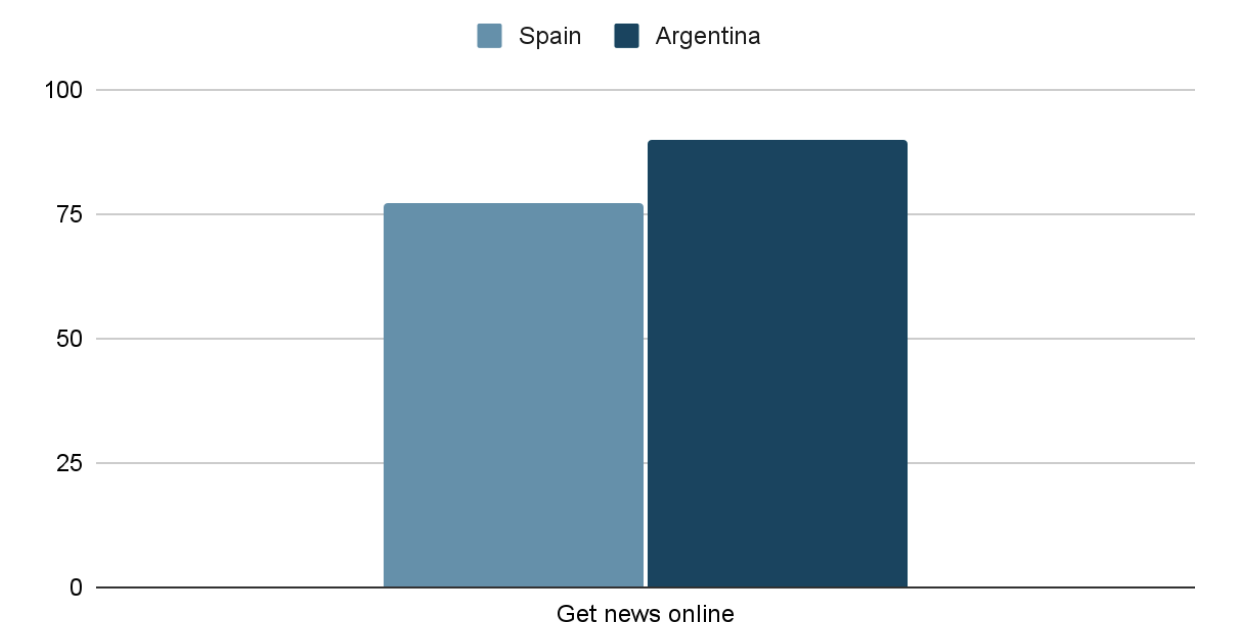
When comparing Spain and Argentina’s online news viewership, Spain citizens are said to get 77% of their news online in 2022 (Statista), whereas in 2020 Argentina citizens were said to get 90% of their news online (Statista). This is showing the relevance of digital media in Spain and Argentina, something Hallin and Mancini didn’t take into account when researching the development of media markets. Mattoni and Ceccobelli did when writing Comparing hybrid media systems in the digital age: A theoretical framework for analysis. They suggested a hybrid media system when comparing media systems because of the new digital age, stating that the digital age makes it impossible for any country to fit into these dimensions (Mattoni and Ceccobelli). Digital media is so important when comparing media systems, which is why Hallin and Mancini’s research on media markets is flawed in this component.
Daily Readership Subscribers of Spain and Argentina’s Press (Online and Offline)
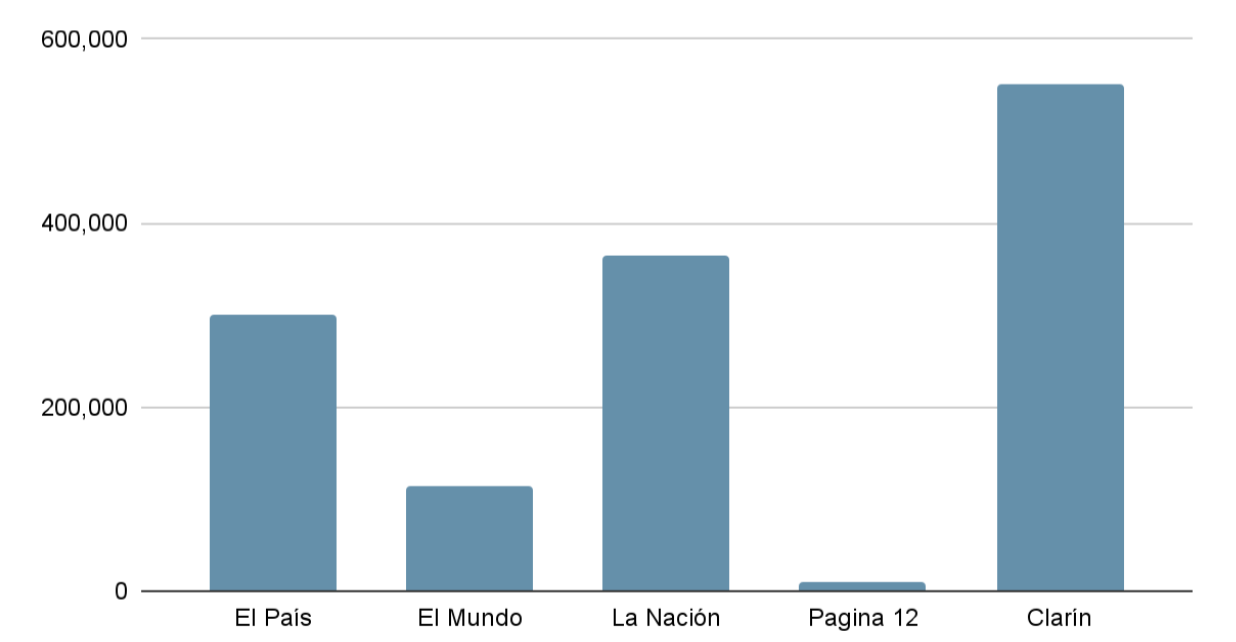
When comparing the daily readership of specific news outlets in Spain and Argentina, both online and offline, it is easily noticed that each country has at least two widespread presses. Spain’s El País generates 300,000 subscribers, 264,000 of them being online subscribers. Additionally, Spain’s El Mundo is second to El País at 115,000 (Reuters Institute, 2023). In Argentina, Clarín leads in subscriptions with 550,000 digital subscriptions and 150,000 print. La Nacíon is second to Clarín at 365,000 (Reuters Institute, 2023). Pagina 12, for the sake of this article, only generates 10,000 subscriptions and is online only (Euro Topics).
Political Parallelism
Political Parallelism refers to the extent the media aligns with political agendas. If a media outlet has high political parallelism, then they are blatantly associated with a certain political agenda. On the contrary, low political parallelism means there is more of a neutral stance within the media and an avoidance of any political alignment. When looking at our two countries, Spain and Argentina, Spain shows less political parallelism, whereas Argentina shows more. However, both show relatively high political parallelism.
Argentina aligns most within the realm of political parallelism and falls under Hallin and Mancini’s polarized pluralist model because of its media alignment with political leanings (Kitzberger, 2022). Kitzberger’s research uncovers the political agenda of Néstor Kirchner,
former president of Argentina, and how it aided to the political parallelism present in Argentina. While looking at the two news outlets, La Nación and Página 12, there is a clear political leaning for each, especially when it was under the control of Kirchner. Clarín also tailored their headlines to fit Kirchner’s left-leaning ideologies (Kitzberger, 2022). This directly falls under the polarized pluralist model, which refers to made-to-fit political agendas with the media. However, Mastrini and Espada state, “according to Hallin and Mancini (2007), media systems in Latin America do not strictly fit into any of these three models proposed in their classic work (2004). In a specific article for the region, Latin American media can be considered a hybrid typology that presents coincidences both with the polarized pluralist model and the liberal one” (Mastrini, Espada, 2024). While looking at the press freedom index from Reporters Without Borders, Argentina ranks 115 on the political indicator. This concludes that Argentina’s media is unsupported and highly regulated. Reporters without Borders states that because of Javier Milei, President of Argentina, and his threats towards journalists, press freedom has been threatened, resulting in a high ranking on the index, especially in the political realm.
Spain also aligns with the polarized pluralist model, showing high political parallelism within the media. Spain's news outlets, like many countries, focus their news based on the opposite political party, spewing news that makes the other party look or sound bad. For
example, El Paíz, left-leaning, and El Mundo, right-leaning, are two of the major news outlets that contribute to this type of polarized news (Baumgartner, Chaqués Bonafont, 2015). On the press freedom index from Reporters Without Borders, Spain ranks 26th on the political indicator category. This means that there is a moderate level of support for the media that the government holds. According to Reporters Without Borders, this score reflects the blurred line between opinion and fact-based reporting in Spain, causing high partisanship. There have also been dangerous lawsuits that threaten journalists politically, overall threatening access to press freedom. It is reasonable to assume that because Spain's president is far right-leaning, their ranking moved due to that.
The Characteristics of Journalistic Professionalism
According to Hallin and Mancini, the Characteristics of Journalistic Professionalism are defined by objective or opinionated news. When there is a narrow line between opinion and fact, there is a low rate of professionalism. However, if there is a clear path of ethical standards and independence in the press, then there is high professionalism shown. Hallin and Mancini decide the state of professionalism based on autonomy and public service orientation. Autonomy refers to whether a journalist stays objective instead of opinionated, as well as deciding what has newsworthiness no matter what their political views are. Public service orientation refers to
public trust and if journalists adhere to their duties of serving the public objectively (Hallin, Mancini, 2004). Both Spain and Argentina tend to blend the lines between fact-based and opinionated news.
Spain was categorized by Hallin and Mancini to be a polarized pluralist, and that remains true today. However, Spain is known to have external pluralism within their media system, meaning they have multiple diverse media outlets with various voices (Barrera, 2010). They still fall in line with having a low degree of professionalism, though, because often Spanish journalists will blend both fact and opinion according to Reporters Without Borders. Scholars Andreu Casero-Ripollés, José Fernández-Beaumont, and José Vicente García Santamaría, who wrote, The politicisation of journalism in Spain: three obstacles to the professional autonomy of journalists, state that due to the politicisation in Spain(Casero-Ripollés, José Fernández-Beaumont, Santamaría, 2015), there is a low degree of autonomy in journalism, one of the characteristics Hallin and Mancini use to determine the degree of professionalization in journalism. It is fair to note that due to the research findings from Reporters Without Borders and Casero-Ripollés, José Fernández-Beaumont, and Santamaría, Spain often manipulates their pieces through politics and opinion.
Argentinian journalists also tend to blend the line of fact and opinion, but they also have a strong stance on press freedom (Reporters Without Borders). According to Reporters Without Borders, Argentina’s president has since stated that he plans to defund community media, which would increasingly make professionalism worse because of the diversified voices, but overall, there has been no censorship process. This dimension was difficult to find any other academic research on for this specific research, which made it difficult to really conclude Argentina’s professionalism.
The Degree and Nature of State Intervention
The Degree and Nature of State Intervention refers to the understanding of government regulation in the media. Showing high state intervention can be supportive of the press as a public service, or it can be restrictive, as more political censorship and regulations. Low state intervention would be where the market dominates, and a more hands-off approach to regulation. Spain’s CNMC, Comisión Nacional de los Mercados y la Competencia, operates as an independent authority (CNMC), aligning with a more supportive state intervention style. While looking at the press freedom index from Reporters Without Borders, Spain's rankings have gone up 7 points, sitting in the satisfactory range at 23rd. According to Reporters Without Borders, political targeting of journalists and lawsuits have decreased press freedom in the media, but the European Media Freedom Act seems to still be in place, aiding a better score (Reporters Without Borders). Overall, Spain operates as an independent authority in the means of regulation and competition, but according to Reporters Without Borders, Spain’s Media Landscape has a high level of concentration, a monopoly market through RTVE, and political interference in the digital media sector. However, their print media is more diverse (Reporters Without Borders).
Argentina’s ENACOM, Ente Nacional De Comunicaciones, is more restrictive and politicized, playing favoritism towards pro-government media. According to Reporters Without Borders press freedom index, Argentina is ranked 87th in the problematic range, a score that has dropped 66 points since 2024. This is due to their President, Javier Milei, and the threats posed against journalists in Argentina (Reporters Without Borders). In addition, Reporters Without Borders mentions that Javier Milei’s press regulations have changed to just a small number of powerful organizations or people having large ownership of the media industry. This can lead to bias in the media and limited viewpoints. What I find most interesting about Argentina’s Media Landscape and state intervention is the pressure they have from politics and businesses, “The right to information and freedom of expression are guaranteed by liberal-inspired laws, but information pluralism suffers from public policy shortcomings and the concentration of media ownership,” (Reporters without Borders).
Conclusions
To conclude, when comparing Argentina and Spain’s media systems with Hallin and Mancini’s research, there are various conclusions to draw upon. One conclusion that I came to was a critique of Hallin and Mancini’s research. When analyzing the development of media markets, Hallin and Mancini based the category primarily on print media, leaving out the space for analysis when it comes to broadcast and online entities. Therefore, it came to my surprise that Spain and Argentina had excellent economies, but poor circulation and development because the press isn’t as important to Spanish and Argentine citizens as broadcast and online media. This is a major flaw in Hallin and Mancini’s research that wasn’t well thought out.
Next, I found the results of political parallelism and professionalism interesting in both countries. Together, both displayed high political parallelism, but what shocked me was that Spain was highly polarized as well. I say this because Argentina was more regulated and
unsupported by the government than Spain, which has more of an independent press, with higher press freedom. I wasn’t expecting there to be much political parallelism, but instead more critical of politics and those in power. I wasn’t as shocked about Argentina fitting into the political pluralist model due to their current president and ranking on the press freedom index from Reporters Without Borders.
Additionally, I found comparing Argentina to Hallin and Mancini’s system much more difficult than doing so for a European country like Spain. With that being said, I do not necessarily agree that Hallin and Mancini’s research perfectly fits Latin American countries, a
flaw that I request be revisited and taken into account for future academic research. Spain was much easier to research because it was one of the countries Hallin and Mancini based their research on. Overall, I do believe that Argentina fits into the polarized pluralist model; there were a few of the four dimensions I struggled to fit my research into. Like I mentioned in my Unit 2 Reaction Essay, reacting to Hallin and Mancini’s research, “I learned that comparing media systems is crucial in the world of media, but I lacked the information beyond the rich, Western countries where the media systems were researched. I would suggest having a more diverse set of countries where media systems aren’t easily comparable to make the research stand out further” (Lein, 2025). This critique still applies, but this time I was seeing firsthand in my research on Argentina where these flaws lay.
Next, when thinking about the comparisons of state intervention I wasn’t too shocked to find that Spain has more press freedom, but what shocked me was understanding how they have a limited development of media market and high political parallelism when following Hallin and Mancini’s framework, with my research and conclusions, I do not believe that Spain and Argentina should be categorized the same as political pluralist. This is where the criticisms of Hallin and Mancini from Mattoni and Ceccobelli, and Albuquerque come to play because these researchers understood the influence digital media has on the comparison of media markets
today. Overall, this research did the most when answering my main research question, how do political and economic factors shape media systems in Spain and Argentina, and what similarities and differences exist in their media regulation and press freedom, because it comes to show how much of an impact politics have on media systems. However, my previous findings about the economy of each country had me questioning how Hallin and Mancini’s research is relevant in today’s digital age because of the economic landscape of media systems.
My final thought is how extraordinary it is to see how many academics use Hallin and Mancini’s research to support their own. What I have learned throughout this process of my first academic research article is that research overlaps, and you don’t necessarily need to agree with each piece of research that is in one academic article. Instead, you can create your analysis through a combination of research findings from multiple scholars. Overall, when thinking about the comparison of these two countries and what I have learned about global media, I think the most important aspect to add is that global media is constantly changing, and research must change with it. I also have learned from this assignment that not all systems fit within certain countries, and you cannot make them fit. To end, this has contributed to my learning not only in this class, but also will be taken with me in my future endeavors.
References
Barrera, C. (2008). Spain: Media System. The International Encyclopedia of Communication.
Baumgartner, F. R., & Chaqués Bonafont, L. (2015). All News is Bad News: Newspaper
Coverage of Political Parties in Spain. Political Communication, 32(2), 268–291.
https://doi.org/10.1080/10584609.2014.919974
BBC. (2023, February 7). Argentina media guide. BBC News. https://www.bbc.com/news/world-
latin-america-18707517
Casero-Ripolles, A., García Santamaría, J. V., & Fernández-Beaumont Fernández, J. (2015). The
politicisation of journalism in Spain: three obstacles to the professional autonomy of journalists.
Anàlisi: quaderns de comunicació i cultura, (53), 0095-109.
CNMC (Comisión Nacional de los mercados y la competencia). RIRM. (n.d.).
https://www.rirm.org/en/cnmc-comision-nacional-de-los-mercados-y-competencia-2/#:~:te
xt=The%20Spain%27s%20National%20Authority%20for,2013%20of%20June%204%2C
%202013.
de Albuquerque, A. (2023). Transitions to nowhere: Western teleology and regime-type
classification. International Communication Gazette, 85(6), 479-497.
Ente Nacional de Comunicaciones. (n.d.). https://www.enacom.gob.ar/
GDP by country. Worldometer. (n.d.). https://www.worldometers.info/gdp/gdp-by-country/
Guttmann, A. (2023, January 5). Tools for online news consumption by age Argentina.
Statista. https://www.statista.com/statistics/1179034/devices-digital-news-media-age-argentina/
Hallin, D. C., & Mancini, P. (2004). Comparing media systems: Three models of media and
politics. Cambridge university press.
Hallin, D. C., & Mancini, P. (2017). Ten years after comparing media systems: What have we
learned?. Political communication, 34(2), 155-171.
Kitzberger, P. (2022). Media-Politics Parallelism and Populism/Anti-populism Divides in Latin
America: Evidence from Argentina. Political Communication, 40(1), 69–91.
https://doi.org/10.1080/10584609.2022.2124334
Mattoni, A., & Ceccobelli, D. (2018). Comparing hybrid media systems in the digital age: A
theoretical framework for analysis. European journal of communication, 33(5), 540-557.
Mastrini, G., & Espada, A. (2024). Media System. Media Compass: A Companion to
International Media Landscapes, 196.
Mitchelstein, E., & Boczkowski, P. J. (2023, June 14). Argentina. Reuters Institute for the Study
of Journalism.
https://reutersinstitute.politics.ox.ac.uk/digital-news-report/2023/argentina#:~:text=The%2
0decline%20of%20printed%20newspaper,membership%20programmes%20to%20generat
e%20revenue.
Newspapers & Magazines - Argentina: Market forecast. Statista. (n.d.).
https://www.statista.com/outlook/amo/media/newspapers-magazines/argentina
Página/12. eurotopics.net. (n.d.). https://www.eurotopics.net/en/155261/pagina-12#
Reporters without Borders. Bienvenue sur le site de Reporters sans frontières. (2025, May 5).
https://rsf.org/en
Spanish news and Media. NYU Madrid Hub. (n.d.). https://wp.nyu.edu/nyumadrid/spanish-news-
and-media/
Statista Research Department. (2025, February 28). Spain: People reading news online 2013-
2022. Statista.
https://www.statista.com/statistics/1237667/spain-internet-users-reading-online-news/#:~:t
ext=In%202022%2C%20the%20share%20of%20internet%20users,Communication%20Te
chnologies%20(ICT)%20in%20households%20and%20by
Stoll, J. (2024, May 22). Television penetration Spain 2023. Statista.
https://www.statista.com/statistics/436470/television-penetration-in-spain/#:~:text=The%2
0share%20of%20people%20in,and%202003%2C%20at%2090.7%20percent.
The media in Argentina. Argentina Media. (n.d.). https://www.whatargentina.com/argentina-
media.html
Vara, A., Negredo, S., Moreno, E., Kaufmann, J., & Amoedo, A. (2023, June 14). Spain. Reuters
Institute for the Study of Journalism. https://reutersinstitute.politics.ox.ac.uk/digital-news-
report/2023/spain#:~:text=The%20de
cline%20of%20the%20print,established%20websites%20in%20our%20ranking.
Watson, A. (2024, May 22). Printed daily newspaper readership Spain 2023. Statista.
https://www.statista.com/statistics/436409/newspaper-penetration-in-
spain/#:~:text=Print%20daily%20newspaper%20penetration%20rate%20in%20Spain%201997%2
D2023&text=
Newspaper%20readership%20peaked%20in%202008,of%20declining%20print%20media
%20consumption.
Grace Westergaard
A comparative case study of China and the United Kingdom: How does each country use social media/digital news and the press in terms of infrastructure, ownership, state regulation, and journalistic culture and work?
Author: Grace Westergaard is a third-year student at the University of Iowa studying English and creative writing on the publishing track with a double major in journalism and mass communication.
Introduction
In this paper, my intention is to answer the research question: How different are China’s and the United Kingdom’s media landscapes in terms of social media reporting and journalistic culture, as well as the rise of digital publications, all in relation to the governing system and global reach of each country? Previous research has shown that, across the world, media systems and landscapes vary drastically due to the different factors, cultures, and political interplay at work. (Hallin and Mancini) China, for example, has a media system that is “a combination of different media philosophies,” and “is the result of the long history of Chinese civilization. In this system, the Chinese Communist Party, government, private enterprises, media professionals, public individuals and Chinese culture play different roles and provide different forces from difference directions and indifferent fashions.” (Luo, 2015, p. 49) As for the United Kingdom’s media landscape, that is “characterized by a strongly partisan mass circulation commercial national
press and system of public service broadcasting led by the BCC. A sharp distinction exists between the quality and tabloid national press and between the regimes that govern the print and broadcast media.” (Firmstone, 2018, p. 2)
In order to go beyond Hallin and Mancini’s (2004) arguments and advance the media systems scholarship, this paper is particularly interested in understanding not only how digital news has gained a strong readership in contrast to press, but also how journalists of China and the United Kingdom are handling this rise of digital news. These countries are especially relevant to compare as they have increasingly different governmental systems and perspectives about news (according to Luo’s paper and Taylor’s paper) and about social media that will demonstrate just how different media systems across the world can be.
Literature review/theoretical framework
There are many fruitful sources of information that I used as a starting point for my research regarding the United Kingdom and China; as for China, I began with “Counter-hegemonic collaborations or alliances of the underdogs? The case of TeleSUR with Al-Mayadeen, RT and CGTN” by Pablo Sebastian Morales. Through a comparison of qualitative and quantitative data from each country’s broadcast situation and collaboration, Morales—other countries aside—revealed that CGTN and Chinese news networks is extremely interested in spreading their agenda internationally, culture-wise, and is becoming one of the leading forces in the international media arena, which puts it ahead of its allies and creates somewhat of an imbalance. Similarly, in “Hybridizing journalism: clash of two “journalisms” in Africa” by Emeka Umejei is concerned with describing China’s media expansion into Africa, which aimed to spread the
teachings of the government and Chinese communist party. The main question of the article surrounded whether or not China’s expansion could displace the libertarian journalistic orientation in Africa. Through Shoemaker and Reese’s hierarchy of influence model and interviews with African journalists working in CCTV, the author proposes that a hybrid form of journalism was created rather than a full-stop China takeover, and “the import of this is that both Chinese and Western journalistic traditions would exist on the African continent,” as China had previously adopted some Western ideologies as well. (Umejei, 2018, p. 12)
Another article that aided in my understanding of China’s media landscape was “The two-way flow of news: a comparative study of American and Chinese newspaper coverage of Beijing’s air pollution” by Ran Duan. Through the hierarchy of influence model and content analysis frameworks, that China mostly used Chinese sources to cover the air pollution and relied on self-legitimizing rhetoric in terms of highlighting solutions, which differed from the
United States approach given in the article. An illuminating article that furthered my understanding of the Chinese media system was “Media system in China: a Chinese perspective” by Austin Jun Luo. From my prior knowledge and other articles I had read, it seemed almost like China had this media system that existed in a league of its own, dominating the media space and constantly evolving. But in this article, I learned that the media system in China is not that different from systems in other countries. Using analyses of many forces of the Chinese media system (the communist party, government, private enterprises, media professionals, public individuals, and Chinese culture), the paper worked to explore the phenomena of Chinese media. In the end, the author reveals that “Party Force, Governmental Force, Capital Force and Individual Force can physically control media, whereas Professional and Cultural Forced can only impact media in intangible ways. Regarding regulation, Governmental Force dominates
regulation, although other forces influence it when government officials make any decision.” (Luo, 2015, p. 65) In short, media is often controlled by the government, and other things are less easily defined, like cultural implications. “The overall media philosophy behind the media system in China is a combination of Communism, Authoritarianism, Liberalism, Professionalism, Democratic-Participant and Chinese Culturalism,” (Luo, 2015, p.65) which
means that the Chinese governmental system is more complex than I initially believed. From reading “China Central Television CCTV News” by John Jirik, I learned that CCTV, a global 24- hour English language channel run by CCTV, whose goal is to provide news about PRC and Taiwan that doesn’t conflict with governmental policy and to provide news about global happenings from a PRC perceptive, is “an instrument of state power and committed to becoming
an international news channel.” (Jirik, 2011, p. 1) This is consistent with other accounts of China media being seen as a piece of power governed by the state and something to be used as an agenda-pusher.
As for media regulation and control—from “China: Media System” by Shuhua Zhou—I gathered that the Chinese government has the authority to screen, ban, and censor any print, electronic, or internet publication, and they have the power to “deny people the right to publish and to completely shut down any publisher that fails to follow its dictates.” (Wiley, 2015, p.1) The internet is another pertinent factor of Chinese media systems: “Today, there are 632 million
Internet users… 46.9 percent of the country’s total population… although, its Internet population lags behind those of nations like South Korea, the United States, Japan, Brazil, and Russia.” (Zhou, 2015, p. 3) It’s also noted that there’s a trend in that a large portion of Chinese people use their cell phones to use the internet (527 million). While government control remains strong, there’s more nuances to the Chinese media system overall. There is a good amount of research on the United Kingdom’s media system as well. The article that I used as a starting point was “Ten Years After Comparing Media Systems: What Have We Learned?” by Hallin and Mancini. The goal of the article is to review the research published since the initial release of Comparing Media Systems. They focus on the original 18 countries described in the first publication but develop their model and quantitative measures to get a clearer picture of what the data should look like now. The United Kingdom is included in the “Central cluster,” which reveals that the United Kingdom follows a more liberal model of journalism, which is “characterized by a high degree of professionalism without strong press councils or journalist unions.” (Hallin, 2017, p. 158) “United Kingdom: Media System” by
Dominic Wring depicts much information about government, media, and operations. The most influential agenda-setting media are those based in London, but the system itself “is based on a hybrid model of ownership and control.” (Wring, 2011, p. 1) “It should be noted that the last two decades have seen a significant shift of policy emphasis from enforcing domestic regulations toward encouraging global competitiveness,” (Wring, 2011, p. 2) which is congruent with China’s goal for global competitiveness as well. BBC is still an important source of news regarding radio and television, but “there has also been a rapid expansion in access to the Internet. In 1998, less than 10 percent of households had online access; by 2010, this has risen to 73 percent. Traditional media organizations have been particularly proactive in developing their online presence, and the BBC and Guardian Unlimited boast two of the most visited news sites, attracting significant traffic from outside as well as within the UK.” (Wring, 2011, p. 6). The United Kingdom’s media system has changed drastically, some of the change in part due to the uptake of Internet use. In “The media system,” by Rose Taylor, Taylor also backs the notion that digital media has caused significant growth for media in the United Kingdom, but that “the biggest source of concern about the democratic qualities of the UK’s media system has been that most of the press perennially back the Conservative Party (in very forceful ways in most cases). Fewer papers normally back Labour, and the Liberal Democrats receive only episodic support from smaller papers.” (Taylor, 2018, p. 124) The media is less controlled by government, but papers still have biases, just as they do in many other parts of the world.
However, in recent years, newspapers have closed along with the rise of digital publications, and the uptick in online paywalls has been noticeable as well. “The Times and Financial Times continued to maintain online paywalls to fund their journalism, with the Telegraph also erecting a partial paywall… However, only 3% of Britons have an online news subscription, one of the lowest percentages across the European Union.” (Taylor, 2018, p. 131) As noted in the article,
the UK’s media companies strive to be independent, self-regulatory bodies, but the concept is nuanced and is often subject to problems. But the “Index on Censorship warned that section 40 ‘protects the rich and powerful and is a gift to the corrupt and conniving to silence investigative journalists—particularly media outfits that don’t have very deep pockets,” and, later, it was “announced that section 40 would be repealed… leaving the shape, let alone the effectiveness, of any future press regulation or self-regulation unclear.” (Taylor, 2018, 133) Just as China’s press
freedom is stripped, the UK’s is in some instances as well. In “the missing link: the quality of UK local and national online media coverage of research”, the value of reporting in connection to academic researched is explicitly stated. Media is described as “the public’s first point of contact with, and key source of information about, science and research,” which leads to a trust in the media for making that information accessible and easy to understand. (Tattersall, 2023, p.1) Through a search that produced 8,969 results, it was discovered that, while the results were explained, external links weren’t sited often, which had stakes in commercial matters. This connects to the flow of commerce within newspapers of all countries, as that is something many different media systems harp on.
Methods
To begin my research, I will draw initial conclusions based on my literature review. Now that I have foundational knowledge about the United Kingdom and China, I will use a few databases and sets of data to create a firmer sense of comparison and similarities between the two countries. In short, my primary source of data will come from databases, and my secondary source will come from the academic articles previously described. First, I will use “Statista” (as
this database contains data about both countries regarding similar social media queries) statistics and facts about the social media usage in China and the United Kingdom, as social media usage is a big concern of my paper—how is it used in each country, how popular is it, and what effect does it have on journalistic work in the highly digital age we’re living in? Statista is a widely popular database and contains hundreds of different informational sets regarding many countries. As for types of data, I will review, charts, graphics, percentages, and different sets of data for specific nuances within social media use for each country to get a better picture of what usage looks like. For my methodological approach, I will use a combination of literature review and descriptive analysis to review the data and find out how similar and/or different the United Kingdom and China are regarding social media, journalistic culture, and governmental ownership.
Results
I reviewed data and charts on Statista about the social media penetration rate within China and the United Kingdom, which refers to the percentage of a total population that frequently uses social media application and platforms. “In 2023, the social media penetration rate of China figured at 74 percent, approximately 1.06 billion active users. On average each internet users had about 6.5 social media accounts.” (Thomala, 2024) From 2020 to 2023, the number of social media users increased by about ten percent. By comparison, the United Kingdom has “54.8 million active users as of February 2025, representing 79 percent of the population. This penetration rate surpasses the global average of 63.9 percent, positioning the UK has a leader in social media adoption. The country’s high usage reflected a broader trend of increasing social media engagement worldwide, particularly in Northern and Western Europe.” (Dixon, 2025)
App-wise, the United Kingdom and China use a plethora of different social media platforms, but a couple reign supreme across each country. For China, “WeChat is one of the most popular mobile messenger apps worldwide,” and “achieved over 1.1 billion active users since 2018 and the figure has been increasing steadily.” (Thomala, 2024) WeChat is known as the most popular social media platform in China. For the United Kingdom, WhatsApp is the most popular platform, boasting a 79.9% by usage rate. “Facebook was very close behind, with a rate of 72.3 percent, followed by Facebook Messenger with 56.6 percent.” (Dixon, 2025) When considering both countries and the data, there a few discrepancies year-wise, ablet their closeness, which means comparisons can be made. Statista provided a great starting point for my database research, using a variety of different data sets to help me gain an understanding of social media use and platforms in each country. I do wish there was a better chance at finding the same year’s- worth of data, but otherwise the data appears to be accurate for the purposes of this paper.
Discussion and Conclusions
Based on my descriptive analysis, there are many conclusions and speculations I could draw on the grounds of social media use and journalism between China and the United Kingdom. Since the United Kingdom has 54.8 million active users as of last year and China has 1.06 billion active users as of 2024, it appears that, while social media is becoming important everywhere, it’s even more so in China. In relation to journalism, this could mean that more Chinese news
outlets are using online resources to publish their work than United Kingdom news outlets. However, the United Kingdom is the leading social media adopter, as their penetration rate passes the global average of 69.3 percent. Interestingly, the Chinese penetration rate is even higher than that, which is a staggering 74 percent. By comparison, China is doing more with social media and penetration than the United Kingdom is. Platform-wise, China has an affinity
for WeChat and the United Kingdom uses Whatsapp the most often, neither of which are apps particularly known for their publication opportunities for journalists. I was hard-pressed to find data about platforms that have more applications for blogging or journalistic work for either country. As for my literature review in connection to the data found, there are some interesting connections that I would like to point out. As for government control, Chinese officials can regulate any journalistic work; the country is dominated by the communist party. The United Kingdom has less government control, but the papers still have biases, and the idea of “independent” newspapers is fraught. Control, politics, and government still have a hand in biases and what (or who) journalists report on, which relates to Chinese media more than other papers have let on. Even if I couldn’t find data about platforms where journalists could publish
their work, the literature review provided a wealth of information: the BBC and Guardian Unlimited are some of the highest-visited news sites in the United Kingdom. CCTV is the network mentioned the most in China. Something that fascinated me was that each country valued competitiveness and spreading their agendas through the news on a global scale. For China, their goals are to provide news from their perspective about global-happenings and
broadcasting those findings to other countries and to spread their rhetoric. For example, the article about China hoping to spread their journalistic teachings to Africa that resulted in a hybrid form of journalism by Emeka Umeiei shines some light on this situation—despite the goal being to spread their own agenda, hybrid forms were created, which is the result of a previous hybridity from Western journalism. In relation to the United Kingdom, there has also been a shift toward encouraging global competitiveness, just as there has been in China. The idea of spreading agendas and country-specific information is becoming more and more prevalent across journalistic work and broadcasts, which I see as a direct result of the uprise social media usage. Social media is a global phenomenon that countries like the United Kingdom and China are working to harness; the more countries can get their agendas out into the world, the more powerful they’ll be, which puts the media between a rock and a hard place: is it more important
to be successful as a country, or to report what’s going on globally with no biases in any way, shape, or form? There are a variety of ways in which my findings related to social media, governmental control, global reach, and online news could benefit the scholarship’s understanding of global media systems. Even in my research, I had a tough time finding information about social media and how it impacts media systems in China and the United Kingdom. I believe my paper can serve as a starting point for noticing the ways in which social media and global outreach interact and have conversations with each other. On a larger scale, it’s important to note that journalism seems to be somewhat shifting from watchdog roles to agenda-setters and spreaders across both China and the United Kingdom. I wager that other countries have followed this shift, which is another way my paper could benefit other researchers, as they can notice the shift I’ve pointed out and use it to study the media systems and infrastructures of other countries. Social media is
such a relevant topic that’s highly discussed in the media zeitgeist, and I believe my paper begins the work of filling a small amount of the research gap in terms of social media use and how journalism and journalists are affected by online platforms. Also, in terms of the entire research pool on China and the United Kingdom, I was able to find many articles and data sets about China, but I struggled to find a wide variety of articles and data about the United Kingdom
related to media and journalism. Perhaps my paper can serve as another dent in the United Kingdom research well and add another bit of information to China’s already dense bout of research. My paper is also beneficial in the sense that I cobbled together many research articles about both countries that were tied together by the fact that they were about the same countries, but also that they cover a small part of my research question: How different are China’s and the
United Kingdom’s media landscapes in terms of social media reporting and journalistic culture, as well as the rise of digital publications, all in relation to the governing system and global reach of each country? Each article covered as aspect of government control, social media, and global reach (or, as I learned, agenda-spreading), in a way that provided a framework for how I would approach my research about media systems in China and the United Kingdom, especially focusing on social media. This paper also provides another angle to all the research on China:
while it is a global dominator in terms of media and platform use, it isn’t as different from other media systems as we’ve been led to believe. Furthermore, both the United Kingdom and China hope to increase global reach and broadcasting, meaning both countries strive for competitiveness. I’ll be interested to see how, in the coming years, this competitive nature exacerbates.
There are a few limitations to my study that would like to address. First of all, as I’ve mentioned a few times, I had a tough time finding research on the United Kingdom regarding media systems and social media. I compensated for this by filling other research gaps related to the United Kingdom and finding similar data to the China data I found. Also, the United Kingdom’s data was set in 2025, while China’s was 2024, and I searched to find some that aligned year-wise, but came up short. Overall, while China and the United Kingdom were interesting to compare, future studies could benefit from choosing countries that had much more research readily available on them (at least, for the United Kingdom). Another limitation of my study was that, as social media is so new, there isn’t a lot of research already available in terms of social media and how it effects journalistic work and governmental control. I was really interested in finding information about social media and the effect it has on journalism, and I would love to see future researchers take this question on. On the topic of future research, I have many ideas for how future authors could take the essential questions of my paper and turn them into more studies and data sets. First, doing a survey of journalists in the United Kingdom and China about their thoughts on social media and how they use it would be quite illuminating. Adding questions about government regulation and global reach would add more nuance to the survey and address more of the questions I was wondering about. I would be curious to see if the shift I speculated about in terms of watchdog to agenda-setter in the age of social media and global reach would be reflected in the survey results. I also think doing more individual studies on the United Kingdom and China related to social media would fill the gap I’ve been working
to fill as well. While each country uses social media in different ways across different platform, the idea of online communication and publication reigns true across the globe, and more research dedicated to explicating similarities and differences would be beneficial for the research well on media systems and infrastructures. I would be interested to see more time dedicated to talking about this idea of global reach and agenda spreading through the media—when did the shift occur, and is watchdog even a role journalists perform anymore? Does it directly relate to social
media and the rise of instant communication, as I’ve theorized throughout this paper? A separate study could be done on the effects of government control on journalism and how it relates to social media and/or online journalism in the United Kingdom and China, as their different political systems might provide some mirrors and windows into how control can stifle or foster journalistic work. Another limitation of my study is that I did not do surveys, and, in the completion of my descriptive analysis and literature review, I see how beneficial that would be for my research. As I am a student in the United States, it would be quite tough to conduct my own research about those countries, so I leave it up to future researchers to continue the work I cannot.
References
Dixon, S. (2025). Active social media users in the United Kingdom (UK) 2025.
https://www.statista.com/statistics/507405/uk-active-social-media-and-mobile-social-media-
users/
Dixon, S. (2024, April). Leading social networks in the United Kingdom (UK) 2024, by reach.
https://www.statista.com/statistics/284506/united-kingdom-social-network-penetration/
Firmstone, Julie (February, 2018) The Media Landscape in the United Kingdom, Media
Landscapes: Expert Analyses of the State of the Media, European Journalism Centre (EJC),
https://medialandscapes.org/country/united-kingdom
Hallin, D. C., & Mancini, P. (2016). Ten years after comparing media systems: What have we
learned? Political Communication, 34(2), 155–171.
https://doi.org/10.1080/10584609.2016.1233158
Jirik, J., & Xiaoping, L. (2011). China Central Television CCTV News. The International
Encyclopedia of Communication. https://doi.org/10.1002/9781405186407.wbiecc021.pub2
Luo, A. J. (2015). Media system in China: A Chinese perspective. International Communication
of Chinese Culture, 2(1), 49–67. https://doi.org/10.1007/s40636-015-0012-3
Morales, P. S. (2022). Counter-hegemonic collaborations or alliances of the Underdogs? the case
of telesur with Al-Mayadeen, RT and CGTN. Global Media and Communication, 18(3),
365–382. https://doi.org/10.1177/17427665221125549
15
Tattersall, A., & Carroll, C. (2023). The missing link: The quality of uk local and national online
media coverage of Research. Insights the UKSG Journal, 36.
https://doi.org/10.1629/uksg.624
Taylor, R. (2018). The media system.
https://eprints.lse.ac.uk/115249/1/Taylor_the_media_system_published.pdf
Thomala, L. L. (2024, February). Penetration rate of social media in China from 2020 to 2023.
https://www.statista.com/statistics/234991/penetration-rate-of-social-media-in-china/
Umejei, E. (2018). Hybridizing journalism: Clash of two “journalisms” in Africa. Chinese
Journal of Communication, 11(3), 344–358.
https://doi.org/10.1080/17544750.2018.1473266
Wring, D. (2011). United Kingdom: Media system. The International Encyclopedia of
Communication. https://doi.org/10.1002/9781405186407.wbiecu008.pub2
Zhou, S. (2015). China: Media system. The International Encyclopedia of Communication.
https://doi.org/10.1002/9781405186407.wbiecc022